Where to start with a rock garden
Stones go very well with plants. That is why a rock garden is a very decorative element of a garden. When creating your own rock garden, you first start planning the place where you want to create a rock garden. This is important because even a small rock garden in front of the house attracts attention.
Most often it is created in a sunny place. The location for flowers and shrubs is thought out in detail. Plants that love the sun and dry places can grow here.
Please note! However, it is important to remember that in bright sunlight and in the presence of stones that further increase the temperature, only sun and drought-resistant species will survive in the rock garden. Therefore, they are created in a slightly sunny place, but not in full sun.
Is it possible to arrange an alpine garden in a shady place? Yes, provided that only shade-loving species are selected. These can be plants such as various hostas. However, in a completely shaded place or under trees, it will completely lose its charm.
Where does an alpine slide look best? Much depends on the size of the plot. In a small garden, you should not place it in the middle of the space. The resulting effect will be very unnatural. It will look better in the corner of the garden, near a wall or stairs.
Additional information! If possible, use a natural elevation, such as a slope or wall, which is connected to the rock garden. Installing a rock garden will require less work (it is not necessary to build an elevation from the ground), and it will all look more impressive.
A beautiful rock garden attracts attention, so it is worth creating it where it will be clearly visible, for example, in the front part of the garden, right next to the front door. It looks great in front of the house or in front of the terrace. In a large and varied garden, it can be placed in the center, creating an impressive “stone island” surrounded by plants and garden architecture. Rock gardens also look beautiful surrounded by water. This can be a pond, a stream or a small waterfall.
What shape can a rock garden take?
An alpine slide on a private plot, chosen wisely and tastefully, will allow you to create a luxury zone.
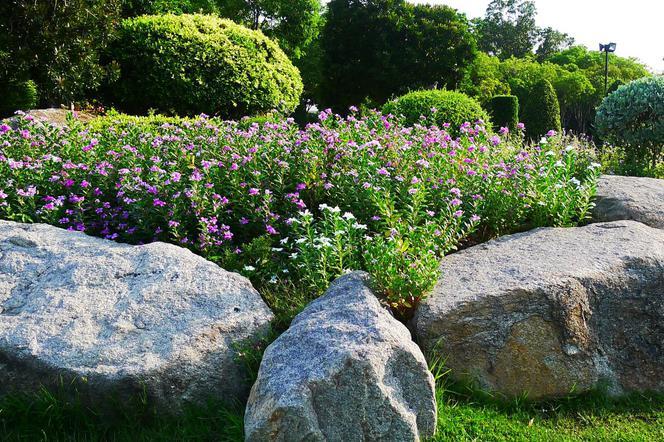
The rocky corner should at least slightly resemble nature. Its shape should be irregular.
- A classic raised rock garden built with different types of stones and plants.
- Similar to a mountain meadow, it imitates mountain slopes, so it should be strongly inclined and made of one type of stone.
- A flat stone bed in which grass is replaced by smaller and larger stones. Between them, plants are planted that match the character of the garden and its location.
- An alpine garden on a wall is an interesting idea for combining plants with architecture. Creeping plants are most often planted on walls in rockeries.
The composition does not necessarily have to be large, so this is an excellent solution for small garden plots.
Alpine slide with your own hands
This may seem like a difficult task, but it is not. Once the location and type of rock garden have been chosen, it is necessary to collect materials for construction: small and large stones, plants that will feel good in the conditions prepared for them.
Prepare the place:
- remove the turf and the top layer of soil by 10 cm;
- a drainage layer of small stones and gravel is created at the bottom;
- add a permeable substrate, such as regular garden soil.
The perimeter is surrounded by large stones, creating a kind of low wall or border. The center is filled with garden soil to form a small hill. Water and put a few more stones on top. Water daily, waiting for the soil to settle. This takes up to two weeks.
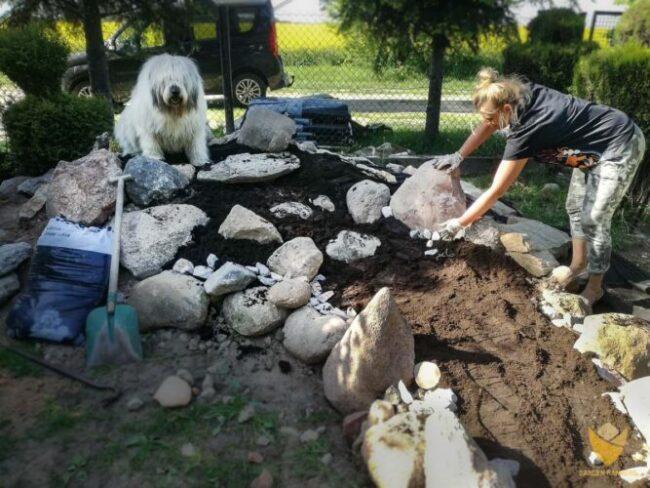
The first plantings are made only when the soil has settled firmly. Only then will the plants be able to take root well in the new place.
Construction of stones
Rockeries usually fit well into the natural landscape of the garden. A composition of plants and stones looks good next to some other architectural element, for example, near a terrace, a house wall, a gazebo or a fence.
Well-chosen stones are the basis of a beautiful rock garden. The shape depends on how much space there is and what the idea of its creation is. It should be as similar as possible to real elements of nature, so it is worth choosing stones of irregular shape, with sharp edges and even slightly cracked ones.
The stones should be dug into the soil to 1/3 of their height, the largest stones should be placed at the very bottom of the rock garden. Gaps and depressions should be filled with soil and watered generously. To make the rock garden look natural, it is best to use one or two types of stones, the same as in other places of the garden – on paths or near the pond.
Planting plants
As for plants for the rock garden, perennials are undoubtedly the most popular. When designing, it is important to correctly arrange the plants and take into account their requirements for lighting and humidity. They should be chosen so that they bloom all season and have contrasting leaves and shape.
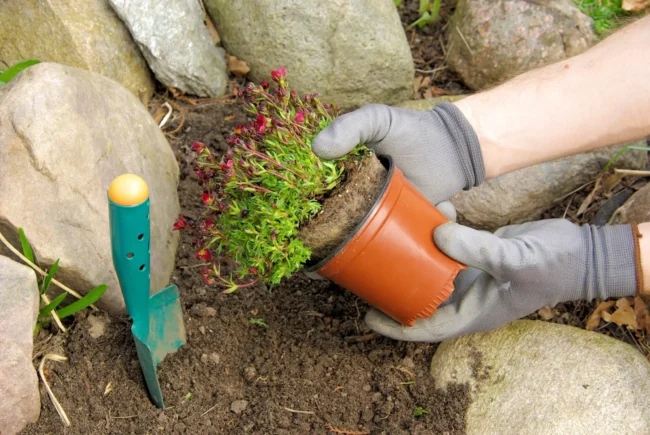
Tall plants are planted at the back, and smaller ones at the front, which will allow you to create a chic composition of several levels. Consider that plants become larger from season to season, leave them room to grow. To achieve an even better effect, you can fill the ground between the plants with gravel or small stones.
The best plants for a rock garden :
Perennial garden flowers are a real decoration, retaining their green color all year round.
- Bergenia is an evergreen herbaceous plant for rockeries; its leaves change color according to the season, decorating the garden even in winter.
- Jagvin blooms abundantly, covering the entire plant with small flowers. Orbieta blooms abundantly throughout the entire season. It retains its green leaves all year round.
- Zaciong. Gray-green leaves and multi-colored flowers are the decoration of this garden plant, which blooms in April and May.
- Veronica – low growing, with beautiful inflorescences, resistant to drying out and available in various colors.
- Gentian is a small perennial plant with beautiful delicate flowers, grows well in rockeries. It blooms with different flowers, such as white, pink, purple and blue.
- Saxifrages have a compact form and bright flowers. They are drought-resistant and tolerate difficult growing conditions well.
- Stone phlox fits perfectly into any landscape and tolerates rock garden conditions well.
In addition to flowering perennials and deciduous shrubs, bulbous plants look great.
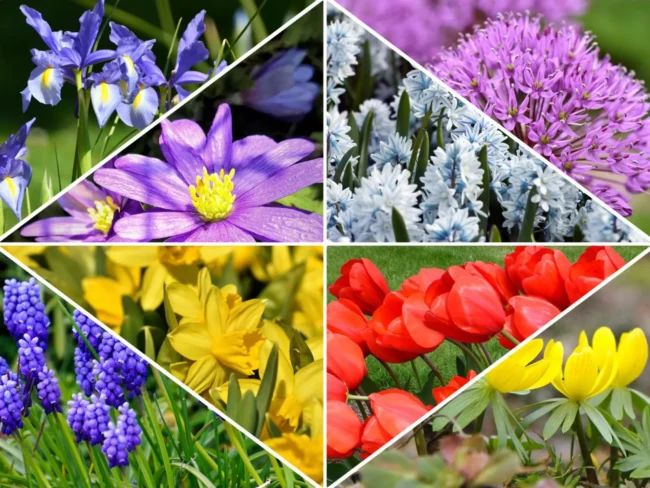
- Crocuses are early bloomers that come in a variety of colors, including shades of purple, yellow, and white. They add color in spring and are drought tolerant.
- Hyacinths bloom in early spring and have beautiful, dense inflorescences. Strongly scented flowers can be white, pink, blue.
- Irises are popular bulbous plants with beautiful blooms. They are available in a variety of colors, including shades of blue, purple, pink and white.
- Many tulip species are short and ideal for rock gardens. They have beautiful flowers that are available in a variety of shapes and colors.
Bulbous plants are a great choice for planting in rock gardens . Their short stature and early flowering make them ideal plants.
Ornamental grasses for rock gardens
Low evergreen grasses look great in rockeries. They are not only beautiful, but also practical, as they are undemanding and easy to care for. Their various forms allow you to create unique compositions in the garden.
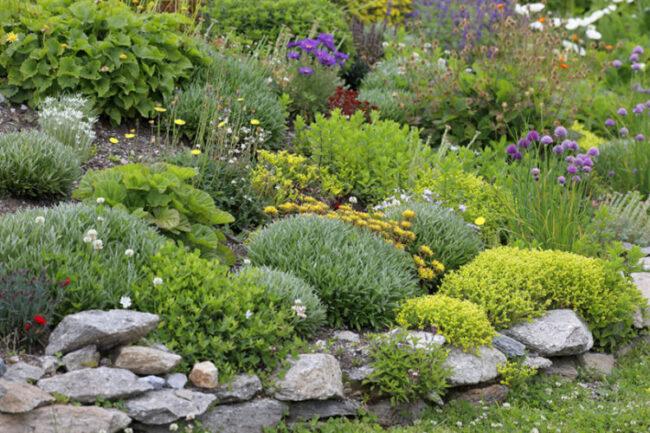
Blue fescue has a unique color in shades of blue. It stands out beautifully among other green plants. The spherical clumps withstand even the most difficult conditions. Blue fescue can be planted with conifers.
Miscanthus – has fluffy inflorescences, used in almost all landscape compositions. Pernisetum with different colors of inflorescences – from white and pink to red and purple.
Popular herbs that look beautiful in the rock garden can also be used in the kitchen. For example, plant thyme, sage, oregano, mint, and yarrow.
Coniferous plants
Choose low and creeping varieties that will be an excellent background for perennials and bulbous flowers. These can be, for example, creeping junipers, pines, larches, thujas.
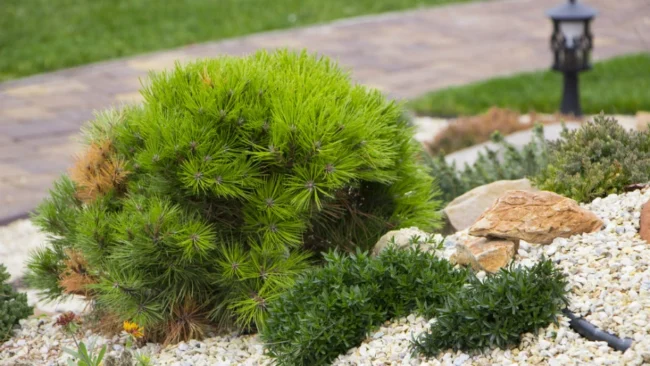
Conifers are planted at the edges because they quickly dominate other smaller plants in the middle.
Juniperus communis is suitable for rock gardens because it likes dry places and grows very slowly. It can easily be given interesting shapes.
Miniature varieties of yew. A bushy plant of interesting shape and very slow growth. Yew ordinary Elegantissima after 10 years reaches a meter in height and 1.5 meters in diameter. The spherical shape of the ordinary yew Compacta is also suitable for an alpine garden.
Japanese thuja has a compact form, and its small size makes it a good plant for rock gardens.
The popular boxwood is easy to shape and can be pruned heavily. If the rockery is located near a fence, it is also worth planting climbing plants there. If the winter is mild, some of them, such as ivy and honeysuckle, retain their leaves all year round.
Other architectural elements
To make the rock garden look natural, it is worth combining it with a wooden bench or a pergola for climbing plants.
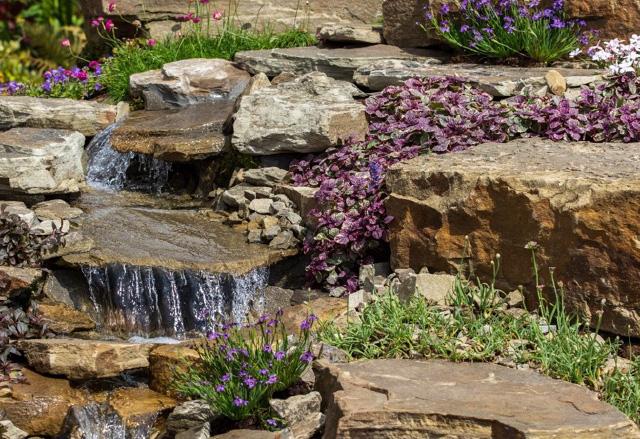
Nearby is a path made of stones or wooden blocks, a pond, a river with a waterfall and a wooden bridge. In summer, you can also place potted plants to diversify the garden decor.