

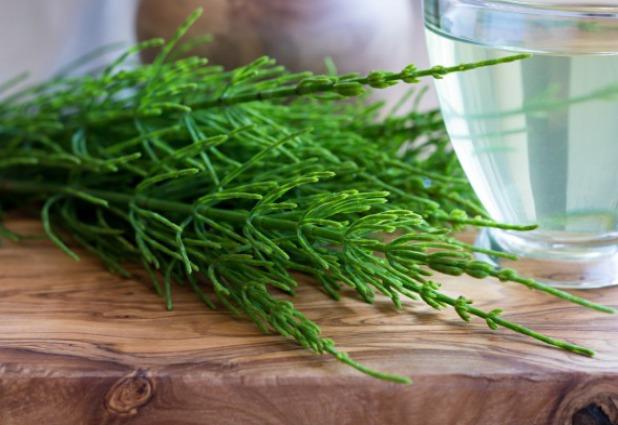
What does horsetail look like?
Horsetail is a perennial plant that grows up to 40 cm in height. Grass is one of the particularly persistent weeds that is difficult to control. It is very difficult to get rid of even with the help of strong herbicides.
Why is horsetail considered a noxious weed? The rhizomes of horsetail are very long and highly branched. They develop to a depth of 130 cm underground. Due to its great ability to regenerate, the plant can grow even from fragments of rhizomes torn off during field work.
Horsetail produces two types of shoots – sporangia and sterile. Only barren shoots of horsetail are collected as plant raw materials. The ability to distinguish between them is very important, since herbal raw materials are only sterile stems.
Note! When collecting grass, be careful not to confuse horsetail with poisonous swamp horsetail and giant horsetail.
Horsetail grows from underground rootstocks and has a unique structure. In early spring, the first to appear are brown, unbranched stems about 30cm high. which bear spore-bearing cones.
How to distinguish sterile horsetail shoots from sporangia?
In early spring, spore-bearing, unbranched stems appear. Once the spores are formed, they die and green summer shoots are produced.
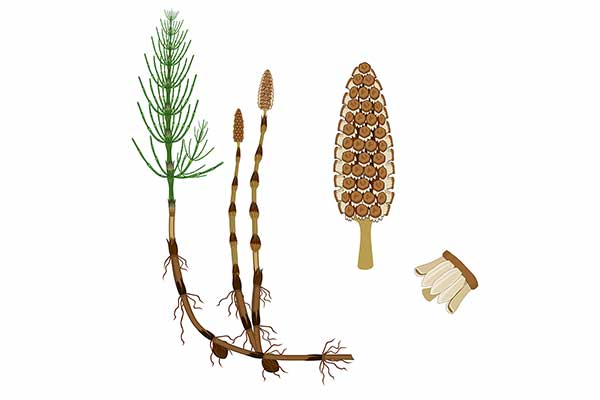
The spore-bearing shoots of horsetail are erect and not branched, light brown or reddish in color. At the top there is a brown blunt thorn 1.5-3 cm long. In the spring, from March to May, spores are formed in them, and when they ripen, these shoots die.
Sterile shoots are branched green, covered with leaves that resemble densely branched Christmas trees. They begin to develop in late spring, reach a height of up to 60 cm and remain on the plant until autumn. There are no sporangia on them.
On what soil does horsetail grow best? It grows well in moist, both clay and sandy soils. It was previously believed that horsetail was an indicator of soil acidity. However, it can grow well in alkaline soils.
Horsetail for plant protection
Summer residents and gardeners use horsetail to protect their crops from pests and plant diseases. Sterile shoots of horsetail are valuable plant raw materials; they are often used in plant protection.
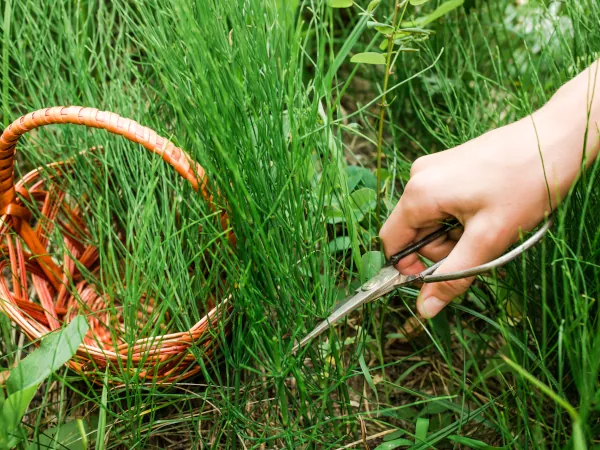
Decoctions, infusions, extracts and liquid fertilizers are easy to prepare yourself from fresh and dried herbs (where 1 kg of fresh herb corresponds to approximately 200 g of dried). This spraying is environmentally friendly and does not pollute the environment in any way and is safe for people and pets. It can be successfully used on organic vegetable and fruit crops.
Horsetail contains silicic acid, which helps fight pests and fungal diseases of plants. In addition to silicic acid, this plant also contains vitamins, organic acids, phytosterols, flavonoids, carotenoids and saponins, which have a great effect on crops.
Note! Horsetail extract and fermented liquid manure have insecticidal properties and are most often used to control colonies of aphids and other pests that feed on garden plants.
Horsetail application. Horsetail preparations can effectively destroy pests that feed on garden plants. Thanks to treatments, you can get rid of pests such as aphids, spider mites, and scale insects without the use of chemicals. Silica (silicon dioxide) upon contact with the membranes of living cells, including insects, damages and weakens them, which contributes to their faster death.
What diseases will horsetail help get rid of? Horsetail reduces the occurrence of diseases such as powdery mildew, apple and pear scab, rust and gray rot. It is also effective in protecting peach leaf curl disease. When growing tomatoes, it is worth using horsetail preparations to combat late blight.
How to prepare preparations from horsetail?
You can make your own home remedies from horsetail, but preparing the spray is a little labor-intensive, but worth spending some time and effort on. You will need from 500 to 1000 g of grass, the green parts of which are cut into small pieces. The prepared raw materials are poured with cold water (a liter of water per 100 g of horsetail) and left for 24 hours.
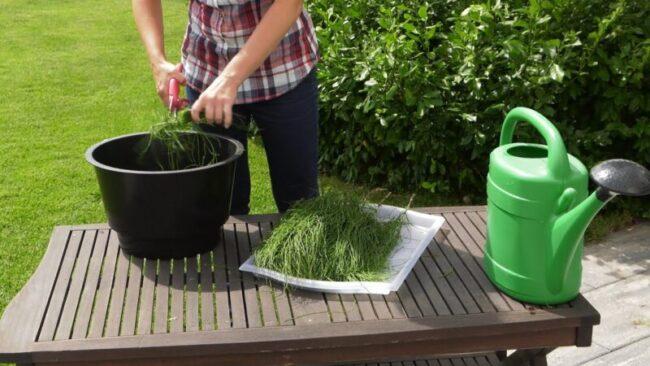
Then cook for 20 minutes and let cool. This releases the ingredients from the plant. The drug prepared in this way is not suitable for storage. Use it immediately after preparation, otherwise it will lose its properties. To enhance the effect of the spray, you can enrich it with dishwashing liquid, choosing environmentally friendly and biodegradable products.
Horsetail fertilizer. How and why is it used?
One of the most commonly used preparations is fermenting horsetail slurry. To prepare it, take 1 kg of fresh grass (or 200 g of dried), mix with 10 liters of water and leave for 4-5 days for fermentation. Stir the mixture daily to facilitate oxygen access. During this time it will ferment and will be ready for use in about 3 weeks. A sign that the liquid manure is ready will be the disappearance of the foam released during fermentation.
When preparing manure from horsetail, unpleasant odors are formed. The smell can be reduced somewhat by adding stone flour, valerian or oak leaves. Horsetail manure can be used to fertilize many plants. It is not suitable only for mint, peas and beans.
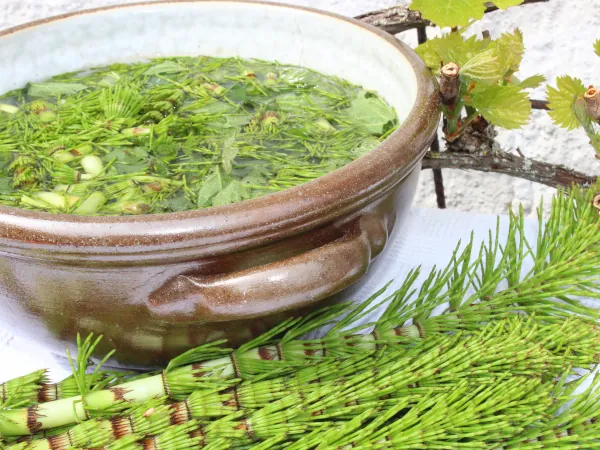
The preparation prepared in this way can be used to spray plants to combat pests such as aphids, spider mites, and scale insects. Before applying horsetail manure to plants, it must be very diluted with water (ratio 1:10).
In case of aphids, you can also use undiluted. 1 kg of fresh horsetail grass or 200 g of dried one is poured into 10 liters of water, but left only for 12 hours. Spray the liquid onto aphid-infested plants.
Horsetail can also help fight fungal plant diseases. Horsetail manure, diluted with water in a ratio of 1:4, is watered directly under the plants. It can be used several times during the growing season.
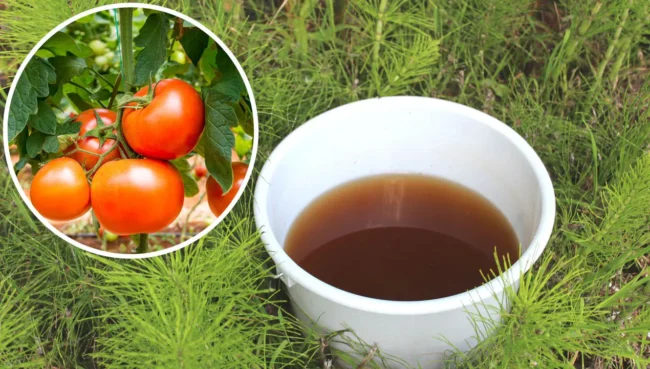
To be effective, spraying should be repeated every 3 days for at least 3 weeks. For spraying, choose sunny days, preferably before noon.
Horsetail decoction is more widely used in the fight against fungal diseases of plants; plants are sprayed against diseases such as gray rot, powdery mildew, rust, apple scab, peach leaf curl. As with horsetail fertilizer, sprays must be repeated every 3 days for at least 3 weeks to achieve full effect.
Horsetail decoction as protection for roses
The main diseases of roses that almost every gardener encounters are rust, black spot and powdery mildew. Horsetail fights powdery mildew and prevents other fungal infections on roses.
Mix the cooled broth in a ratio of 1: 4. Spray roses affected by powdery mildew and other fungal diseases with this mixture several times a day.
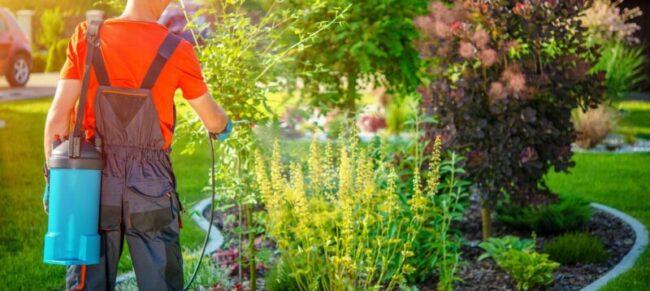
The decoction also has a preventive effect as a means of plant protection, because horsetail strengthens the leaves. To prevent powdery mildew, plants are sprayed once a week.


