

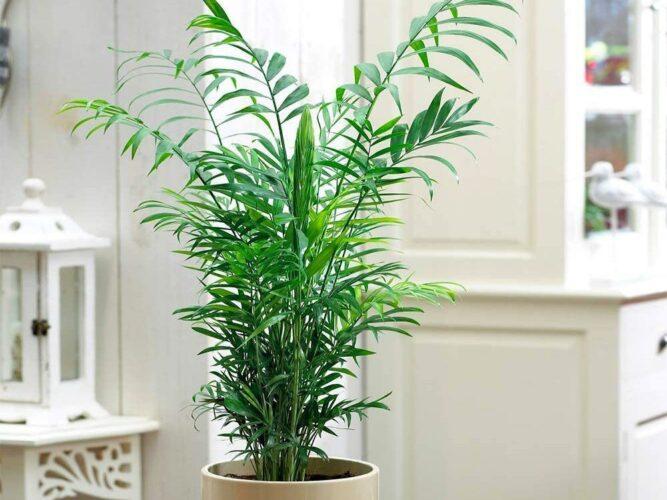
Features of Hamedora palm
A representative of the palm family is naturally found in the forests of Mexico and Guatemala. It reaches a height of about 3 m there. In apartments, this species can reach a height of 1.5 m, but usually grows up to about 60 cm. It is distinguished by large, pinnate leaves, which, when grown at home, can reach a length of up to 60 cm.
Beautiful, dense and brightly colored foliage of the plant has characteristic feathers that look extremely attractive. The growth of the plant is usually slow and you can expect to grow only 2-3 leaves per year. The pinnate leaves of an ornamental palm may have about 15 pairs of lobes. The length of such leaves reaches 20 cm.

Flower stalks may appear from the axils of young plants – fluffy paniculate inflorescences with small yellowish flowers that smell pleasant. After flowering, the palm lays seeds. Small spherical fruits, contain 1 seed. Fruit size is about 0.5 cm.
Hamedora care at home
The plant is easy to grow and is often chosen for interior decoration by people who are just starting to get into green plants. It fits perfectly into many modern interiors.
Note! With proper care, the palm tree flower is durable.
Location and lighting
Caring for an elegant palm tree is easy. The palm tree is undemanding to the level of illumination. The plant can be placed both in a shady corner of the room, and in a bright place with diffused sunlight.
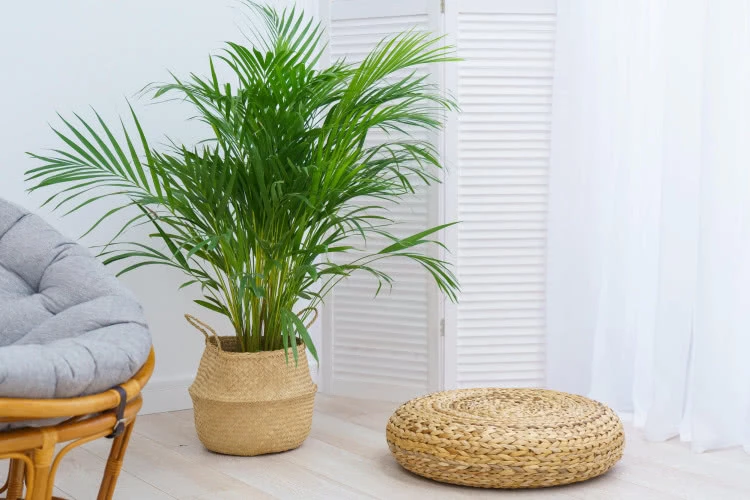
However, when choosing a place, it should be borne in mind that the palm tree does not tolerate direct sun well, as it can burn its leaves.
The soil
Hamedorea develops best in humus soil with a lot of peat, i.e. in light and airy substrate. For this purpose, it is worth purchasing soil intended for palm trees.
Temperature
In summer, it feels best within 20-25°C, while in winter it is recommended to lower the temperature to 12-16°C.
However, at temperatures below 10°C, plant growth may be impaired. At too high a temperature, there is a fear that the leaves will wrinkle, dry out and fall off.
The palm tree has periods of activity and rest. For the summer, a pot with a plant can be taken out to the balcony or even to the garden, placing it in a moderately shaded place. With the onset of cold weather, chamedorea is sent to a shelter for a dormant period, to a cool corner, where it is never warmer than + 16C.
During such hibernation, care should be taken to ensure that the plant pot does not fall into cold drafts. You can ventilate the room a little, but the plant does not perceive sudden changes in temperature very well.
Watering
During the growth period, the palm tree should be evenly moistened, and in no case should it dry out. Therefore, Hamedora needs to be watered abundantly, especially in summer. The plant also does not like overflow, as a result of which the roots rot. The pot must be provided with a sufficient layer of drainage so that water does not stagnate at the roots.
Important! Keep the soil in the pot constantly moist, but do not water too often or pour too much water into the pot. Watering is recommended after the top layer of the substrate in the pot dries slightly.
Excessive drying of the soil often leads to browning of the tips of the leaves. Nevertheless, the plant tolerates temporary drought better than excess water. Pots must have holes through which excess water flows to the bottom filled with drainage.
In winter, it is enough to water the plant once, and in summer two to three times a week. Water the palm tree only when the top of the substrate is slightly dry. For irrigation, settled and moderately warm water is suitable.
Air humidity
Palm flower loves high humidity, so the plant is regularly sprayed. Do not put it next to radiators.
top dressing
The palm tree should be fertilized from early spring to mid-autumn once every 2 weeks with specialized fertilizers intended for palm trees. In winter, you need to stop feeding. Young, newly transplanted specimens do not require top dressing during the year.
Hamedorea transplant
Despite the fact that the palm grows rather slowly, young specimens are transplanted every year. The new pot should be only slightly larger than the previous one. Transplantation of adult plants is carried out less often – once every 3-4 years. Old hamedoras are transplanted only when its roots no longer fit in a pot.
Additional Information! Cutting the plant is not recommended. The plant has only one growth point, its stems do not let branches. If you cut the stem from above, the plant will completely stop growing, it will stop growing, and the leaves below will dry out over time, and can lead to the death of the plant. Sometimes diseased, damaged and shrunken leaves are cut.
Hamedora breeding methods
It can be propagated by sowing seeds and dividing the bush. Hamedorea graceful also bears fruit. Under favorable conditions, the plant can bloom at home. The flowers are small, spherical, yellowish in color and slightly fragrant.
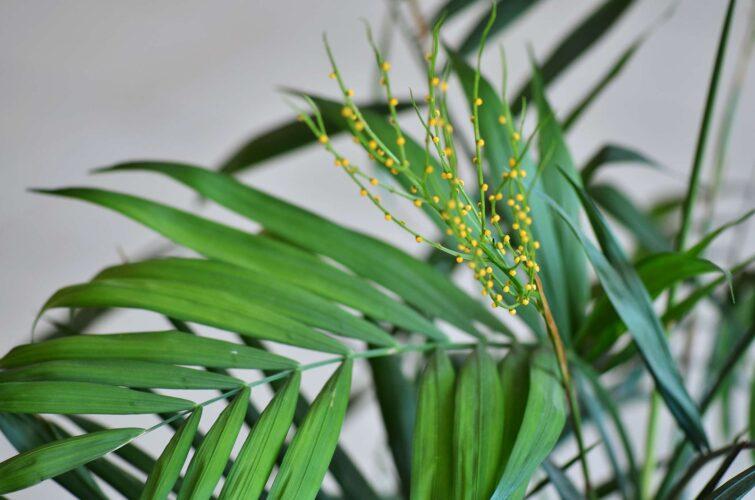
Paniculate inflorescences turn into small, spherical, orange fruits resembling a berry. Seed setting requires hand pollination – transfer pollen with a small soft brush. It is recommended to grow male and female bushes at the same time in order to pollinate them manually.
Seeds for planting can be collected independently or bought in a store. To propagate by seeds, high temperature and constant humidity are needed for germination. Such conditions can be obtained in specialized greenhouses.
The process of emergence of seedlings can last from a month to six months. The seedlings grown in this way will bloom in 3-4 years, when the size of the bush reaches at least 30 cm.
The easiest way to propagate a palm tree is to separate it during transplantation.
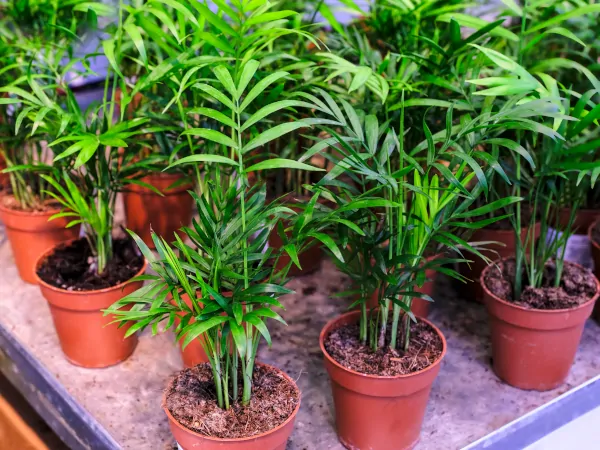
A large overgrown bush is divided into parts with roots, and they are planted in separate pots. Caring for them is no different from caring for the main plant.
Diseases and pests
As a rule, the Hamedorea palm starts to hurt due to improper care. Too low air humidity, excessive or insufficient watering, lack of nutrients are manifested by yellowing, browning and drying of the leaves.
Thrips, scale insects and spider mites can be activated in a dry room. Destroy them with insecticides.
If you water a palm tree too often, without letting the soil dry out, its roots can begin to rot. Wash and remove diseased parts. For disinfection after trimming, sprinkle with charcoal.
Fungal infection appears on the leaves, first with yellow, and then with brown spots, turning into necrosis.
When symptoms of a fungal infection are noticed, plant protection sprays can be used. Palm leaves are not washed with soap or other cleaning products. Dust can only be removed with a slightly damp, clean cloth.


