


What does nasturtium look like?
An annual plant belongs to the Nasturtium family. There are about 80 species from South and Central America.
Nasturtiums have round, dark green leaves that grow from a fairly fleshy stem that can be up to 3-4 meters long. The stems climb on various supports. Nasturtium is easy to grow on terraces, in balcony boxes, trellises, arbors and along walls.

The brightly colored flowers contrast beautifully with the dark green leaves. They come in shades from yellow to orange, red and burgundy, there are also two-tone ones. The most common is the orange variety.
Flowering of nasturtium begins in June-July until autumn. Its flowers are edible, they can be used as a spice, and the leaves and the whole herb are plant materials (antibiotic).
Note! In gardens, large nasturtium effectively repels tomato mealybugs. Planted next to potatoes, radishes, peas, beans, it attracts aphids with its smell. Instead of feeding on cultivated plants, these pests congregate on nasturtiums.
Growing nasturtiums
Likes sunny and slightly shaded places, but does not grow in full shade. It is also not winter hardy.
Nasturtium has no special soil requirements. The soil should be permeable, but not very fertile. Too fertile substrate negatively affects the abundance and quality of flowering.
It is important to remember that nasturtiums do not like too abundant watering and damp soil. It should be watered moderately, trying not to spray the leaves. It also requires regular weeding, as weeds like to grow nearby. The plant can be fertilized with preparations for flowering plants.
When to plant nasturtium?
Nasturtium flowers do not tolerate transplantation well, so it is better to immediately decide on the optimal place.
Additional Information! They do not like the cold, and planting of nasturtiums is carried out only in late spring to avoid night frosts. Therefore, they bloom only in the second half of summer.
Nasturtium flowers appear at the turn of July and August. To make them appear earlier, you can use seedlings, and transfer them to the garden as soon as the last night frosts have passed.

Sow nasturtium seeds in peat pots. When the seedlings have reached the appropriate size, the plants are not removed from the substrate, together with a peat pot, they are planted in their final place. The peat pot will decompose in the soil over time, further fertilizing it. Thus, the risk of transplanting nasturtium seedlings is avoided.
Seeds are sown in the ground or pots in the second half of April or in May, 2-3 seeds per hole at a distance of 20-30 cm from each other.
Note! It is also worth remembering that nasturtium can drown out and dominate the flowers surrounding it, so it is not recommended to plant it in the middle of a border or flower bed.
Watering . Nasturtium does not like too wet soil, but this does not mean that you can completely forget about watering. The abundance and frequency should depend on the position and degree of development of the plant. The sunnier and warmer the place, the more water the nasturtium will need.
Fertilizers. Too much organic fertilizer can cause excessive vegetative growth at the expense of flowering, and excessively poor soils can result in fewer leaves and flowers.
For this reason, we recommend the use of slow-acting fertilizers based on nitrogen or organic humus. Fertilization should be carried out before transplanting or before planting in open ground.
Reproduction of nasturtiums
Most often, nasturtium is propagated by sowing seeds in the ground. Once the seed pods are fully mature, they can be harvested and stored for a new planting. Harvest the seeds when they are slightly brown. If the seed pods do not separate easily from the plant, they are not harvested. Dry the seeds for several days at room temperature, and then store in a paper bag in a dark and cool place for up to three years.
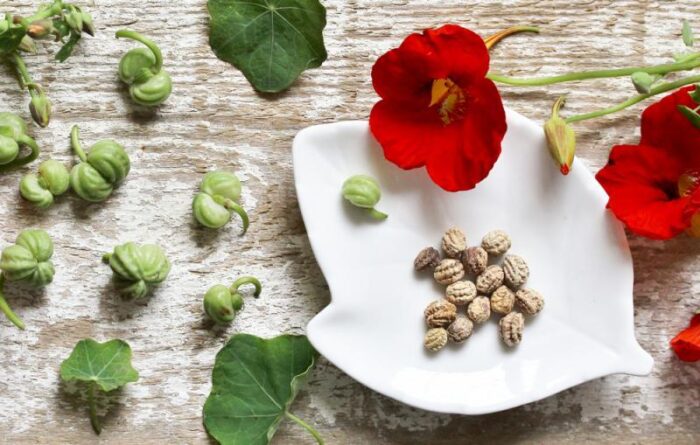
Nasturtiums self-seed very well. Several varieties growing in the same location can cross-pollinate, resulting in new color variations. Rare terry and hybrid varieties of nasturtium are propagated by cuttings in order to preserve species and varietal characteristics during reproduction. They are rooted in wet sand or water, then planted in the ground.
Nasturtium pests
Although nasturtiums help fight various ailments, they themselves become victims of pests. Spider mites and aphids, as well as snails and butterfly caterpillars that feed on nasturtium leaves, will cause the greatest trouble. The taste of nasturtium leaves is appreciated, for example, by caterpillars of a white butterfly.

When growing nasturtium, make sure that pests do not appear (including on the underside of the leaves).
If pests appear on the nasturtium, you should turn to natural plant protection products, for example, water with garlic. Nasturtiums do not tolerate chemicals well, so they should be avoided whenever possible. That’s why it’s so important to keep a close eye on the plant and detect problems early.
Nasturtiums can also become a victim of fungi, especially if they grow near vegetables that are most commonly infected. Then you should turn to fungicides intended for ornamental plants. It is better not to plant tomatoes and peppers next to nasturtiums.
If you use nasturtiums for food, it is better not to fight pests with chemicals. And the sooner they are noticed, the more likely it will be to get rid of them.
Nasturtium: types
In culture, only a few species are used. Initially, nasturtium flowers were slightly different from those now grown in gardens.

These are the work of Dutch gardeners.
- The popular Gleam series includes 6 climbing varieties with double flowers.
- The Tip-Top series combines hybrids with a compact bush up to 30 cm high and simple large flowers in apricot, cream, salmon pink and peach.
- Curly nasturtium: shoots, depending on the variety, can creep or climb up.
- Curly nasturtiums can reach a length of 2 to 4 m. Their leaves are dense, large, covered with a wax coating.
- Nasturtium Tall terry, 60-70 cm high. Large inflorescences of dark red, yellow and orange-pink color.
More and more popular is the large nasturtium, which is most often cultivated in Europe. It is characterized mainly by large colorful flowers and round leaves with long petioles. On the basis of this species, many varieties and hybrids of nasturtium have been created, with different shapes and heights, and flower colors.


