


Godetia description
Godetia flower is a plant from the Primrose family found naturally in North America. In our conditions, this is an annual plant, but due to the ease of cultivation it can often be found in garden plots.
It has several different names and is also known as clarkia graceata, clarkia grandiflora, summer azalea, marshava, or dzierotka. Depending on growing conditions, it can grow to a height of 20 to 60 cm, forming erect, rigid and branched shoots, densely covered with lanceolate leaves.
In the second half of summer, large single flowers with four petals begin to develop on the tops of the shoots. Initially, their shape is bell-shaped, but as they develop, the flowers open and form large inflorescences at the tops of the shoots. The diameter of the flower is 5-8 cm. The petals of the flower are delicate, velvety, wide, slightly wavy at the edges.

Depending on the variety, they can be white, pink, red, orange, purple or bicolor, striped or decorated with spots of a contrasting color. There are also plants with semi-double or lush flowers.
Growing godetia
Flowerbed Godetia feels best in a warm and sunny place, with permeable and moderately fertile soil. They like it when the soil is constantly slightly moist.
Additional Information! In too fertile soil the plant will have more leaves and flowering will be significantly poorer. It is also worth planting it in a place protected from heavy rain. If it rains too much, the plant loses its decorative value, the same thing happens if it is exposed to the sun for too long
Godetia is usually grown from seeds. And although their seeds are very small, they are quite easy to grow even for novice gardeners. Flower growers sow seeds directly in open ground, since large losses may occur when transplanting seedlings.
Godetia when to sow? Sowing is carried out from mid-April to May. The first flowers usually appear 10 weeks after sowing. Godetia seeds are very small, so when sowing you should not cover them with a large amount of soil. During this period, special attention should be paid to sufficiently moistening the substrate, watering it as soon as it begins to dry out.
It is also worth regularly removing weeds that may grow around the young godetia so that it does not have to compete with them for water and nutrients. Experts very often sow seeds for the winter. Flowers planted in late autumn are more resistant to disease and adapt more quickly to the environment. To get a bushier form, you should carefully pinch the small seedlings at the top.
Godetia sowing for seedlings. For sowing, you need to prepare small containers and steamed garden soil or buy a special ready-made soil mixture. Sowing is carried out superficially, the seeds are lightly pressed into the soil, moistened and covered with glass or polyethylene. After about 12-20 days, shoots will appear. From this moment the cover is removed. As soon as 3 true leaves appear, the seedlings can be transplanted. You can plant seedlings in the ground towards the end of May.
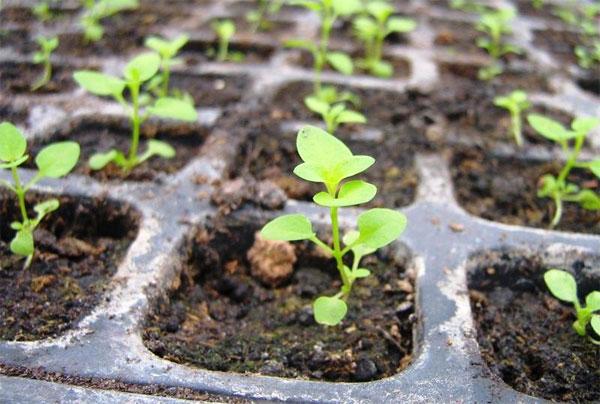
They tolerate temperatures as low as -3°C, so early planting of seedlings in the ground will not harm the annual plant in any way. With dense shoots it is necessary to thin out. Flowering will begin approximately 70-80 days after seeding.
To avoid damaging the root system, the seedlings are replanted along with a piece of soil. The distance between shoots is maintained at 20 cm. It is not recommended to expose young plants to direct sunlight.
Watering
Should be moderate, frequent watering can only be done during drought. When watering flowers, do not get on the leaves, otherwise they will lose their attractive appearance. Once the plant has stabilized, watering can be limited, but remember that Goddecia grown in pots and containers are more sensitive to drying out than those grown in the ground.
Fertilizer
Like many garden plants, godetia needs nutrition. It is very important to fertilize in the spring, before the flowering period. It is recommended to fertilize godetia bushes once every 2 weeks with humate fertilizers. Minerals are essential substances.
Once every 20 days, treat the bushes with a solution: 1 tbsp. nitrophoska per 12 liters of water, stir until completely dissolved. In total, the plant will need 3 feeding sessions over the entire season, and special attention should be paid to the period of active flowering. An excess of beneficial components, as well as their deficiency, can have a detrimental effect on the plant.
Note! Weeds absorb all useful components from the soil, which prevents the full growth and development of godetia. Weeding begins as soon as the first shoots appear. Frequent loosening of the soil is also necessary so that oxygen enters the flower. Godetia will grow and bloom faster.
It is better to remove faded flowers. To collect seeds, it is necessary to leave the largest specimens, this way you can maximize the growing time of godetia. In September, after flowering, you can cut off the seed pods, thus obtaining seeds for sowing next season. If the bolls burst, most seedlings are unlikely to survive the unfavorable winter conditions prevailing in our latitudes.
Godetia grandiflora: use in the garden
Godetia is quite common. The ease of cultivation, long flowering period and incredible appearance of this flower crop have made it one of the favorite garden plants.

Note! Bright and delicate flowers wonderfully enliven garden spaces. They combine with any summer flower, creating bright compositions in flower beds and pots. Godetia flowers are perfect for decorating balconies and terraces. They will look beautiful both individually and in multi-flower arrangements.
Godetia is good because it can be planted in a flower bed with many flowers. The delicate inflorescences of godetia will look very advantageous against the backdrop of the bright long petals of rudbeckia. These flowers complement each other perfectly.
Diseases and pests encountered when growing godetia grandiflora
Like all other plants, godetia, although extremely easy to grow, can fall prey to pests or diseases. Therefore, it is worth knowing the symptoms in order to take appropriate measures to save the plants as soon as possible. The most common diseases affecting godetia include:
- gray rot;
- leaf spotting.
If powdery mildew or downy mildew appears on flowers, fungicides should be used. If you plant the seeds correctly and provide the flowers with proper care, then they are not afraid of pests and diseases.
Godetia is a plant quite resistant to pest attacks. Only spider mites or aphids can pose a serious threat. To prevent infestations, you can use a number of natural methods, such as spraying with garlic extract or infusion, or using essential oils that have a repellent effect (lavender, orange or rosemary).


