


What does petunia look like?
In our climate, petunias are grown as annual plants. These are aromatic plants with erect, creeping or hanging shoots. The leaves are oblong or oval, ovoid. The leaves and shoots are pubescent. Depending on the variety, the plants differ in the size and color of the flowers. The flowers are cup-shaped, wide-open, most often in shades of white, pink, red, purple, violet, and also two-colored.

Petunia varieties with long hanging shoots, called surfia, are especially popular. It blooms from May to November, and after blooming, the flowers do not need to be picked – they dry up and fall off on their own, which makes care easier. It can cope with both high temperatures and heavy rains. Another advantage of this plant is its high resistance to pest attacks and diseases.
Due to the rapid growth rate and abundant flowering, vegetative petunia is demanding of water and nutrients. Therefore, they require frequent watering and fertilizing. It is recommended to add a dose of fertilizer (multi-component preparation for flowering plants) with each watering. In order for the plant to receive the required amount of moisture, it is moderately watered once every three days, under the root.
How to propagate petunia by cuttings?
Some hybrid petunias are propagated not by seeds, but vegetatively. Petunias propagated by cuttings bloom faster and have more developed roots. When propagated, vegetative petunia cuttings retain all the varietal characteristics of the mother plant.
Petunias look great outdoors in spring and summer, but they will not survive winter frosts. Therefore, in the fall, they need to be cut back and moved to a warmer place. This should be done before the first frost, as temperatures below 0° C can be very harmful for them.
Additional information! Are there any specific rules to prepare seedlings for the next season? First of all, you need to choose a healthy, strong plant. It should never be weak or show signs of illness. For cuttings, plants are kept in winter, and in spring, cuttings are cut from the mother bushes.
Petunia cuttings in winter
Petunia bushes overwinter only in bright light and in coolness, but not in cold. The optimum temperature is considered to be from 10 to 12 degrees. They are watered very carefully. You can not save the whole plant, but cut off the cuttings from the bushes and keep them in similar conditions in a light substrate in winter. In the spring, after rooting, they are planted in the garden.
Select a suitable plant and start cutting. Carefully cut off strong shoots with scissors, without signs of disease and wilting. The cut shoot should have two nodal connections, and its length should not be less than 10 centimeters. These should be young flexible stems. They are easy to recognize, because the old ones are thicker, harder and woody.
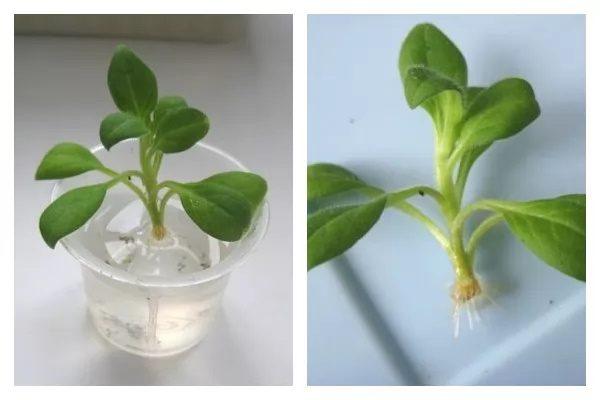
The lower leaves, flowers and buds are torn off from the cuttings, which can weaken them. The shoots are placed in a jar of water for 8-10 days until roots form on them. Then the cutting is planted in the soil. This method does not require close attention and care for the cut shoot. However, it is necessary to monitor whether the shoot is developing roots.
New seedlings can be placed directly into the ground – there is no need to put them in water. The thicker side of the shoot will be facing down. You can soak it in a rooting solution. The seedlings are kept on windowsills or in a greenhouse. The ideal temperature should be above 20° C.
Please note! If the cutting does not develop, a growth stimulating preparation will help. For example, “Energen” or “Kornevin”. It should be added to the water, strictly according to the instructions. In addition to purchased products, you can use natural energy drinks, for example, aloe juice. In addition, make sure that the liquid does not evaporate from the container with the plant. If necessary, add it to the jar.
Once the seedlings have taken root, they should be moved to a windowsill indoors and kept warm. In February or March, they can be moved to larger containers to give them more room to grow. The seedlings should be watered regularly from below.

Make sure that the air temperature in the room where the pots with young sprouts are left does not fall below 18-20° C, and the humidity level is not below 65-75%. The light in the room should be dim.
After 2 weeks, the cut shoots will be strengthened in the soil. Then increase the intensity of lighting. For 8-10 hours, illuminate the shoots with ultraviolet light. The plants should be fed with nitrogen fertilizers.
The plants are sensitive to frost, so they need to be properly protected from low temperatures. It is best to plant them in the garden in mid-May.
Cuttings are a simple and effective way to propagate petunia in your garden. Thanks to it, you can grow fresh bushes that will delight you with bright flowers and greenery until the cold weather sets in.
Growing Petunias from Seeds
However, in amateur conditions, petunia can be grown from seeds. Garden petunia seeds are sown in winter, usually in February. If there is no warm greenhouse, there is a sufficiently warm and light windowsill, preferably next to a window facing south. Petunia seeds are sown in boxes filled with soil for sowing seedlings. Due to the high sensitivity of seedlings to fungal diseases, including late blight, seeds are sown only in sterilized soil.
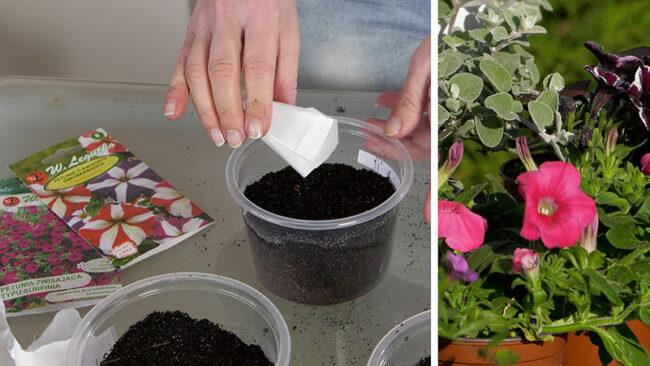
Petunia seeds should not be covered with soil, and after sowing they should only be lightly pressed to the ground. Do not cover boxes with sown petunia seeds with glass or film. At the same time, it is necessary to ensure that the substrate is sufficiently moist so that the soil does not dry out. The appropriate temperature for the emergence of petunias is about 20 ° C.
When the seedlings have 2-3 leaves, they should be transplanted into small pots. Fertilize every 10 days with a diluted multi-component fertilizer, and before planting in open ground, the seedlings must be hardened.


