

How to make a flower bed?
How to design a flowerbed yourself? Decorative flower arrangements can be very beautiful. It just requires proper planning, patience and careful care. With some knowledge about different plant varieties, you can achieve very interesting effects. Flowers can be selected and combined depending on their color.
Before you start planting flowers in a chosen and properly prepared place in front of your house, you need to make a good plan. It is best to draw a plan on a piece of paper. Mark the shape and place individual species and varieties on a piece of paper, taking into account their size, flowering time and requirements.
The design of the flower bed is of great importance. Chaos happens when there are too many different types of plants in a flower bed. Limit yourself to a few and carefully consider the plant’s requirements.
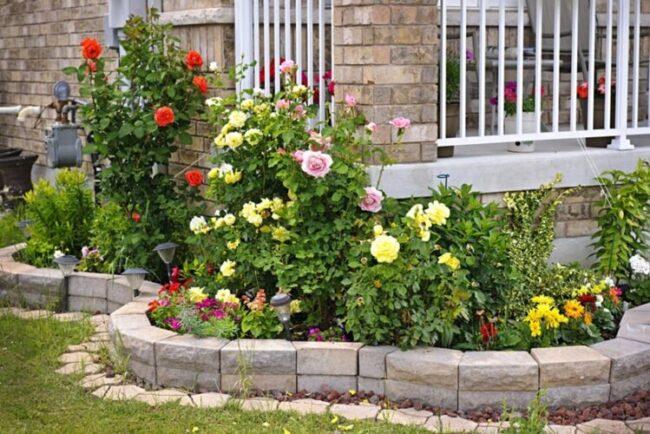
Beautiful flower beds are those that have a natural appearance, which means that flowers should appear in groups. Plants growing nearby should have similar requirements and sizes so that they do not cover or interfere with each other. Low-growing plants are planted in front, and tall plants in the back.

We are often tempted to fill a flowerbed so that the empty spaces are not immediately visible. Small seedlings quickly grow into quite large specimens and will drown out each other.
What types of flower beds are there?
You need to choose the type of flower bed and a suitable location, shape and size of the flower corner. It is equally important to choose plants that will have the best growing conditions.
Flower beds with simple geometric shapes look best and are the easiest to care for. You can divide it into stripes, checkerboard squares, diamonds and triangles, or select several circles lying next to each other. The arrangement does not have to be symmetrical or regular; you can insert one shape into another or arrange flowers in simple patterns.

Plants should be selected so that they have different flowering periods. For a beautiful effect, it is best to combine perennials, bulbous flowers and annual or biennial flowers, to combine the same type and with the same flowering date, but of different colors.
Thanks to the selection of plants, we can distinguish:
- Single-species flower beds are easy to arrange and attractive flower beds in which only one type of flower or flowering shrub grows. Another variety of this type of flower bed is a monochromatic flower bed, in which plants of many species are located in one place, but blooming in one color.

- Multi-species flower beds make up the vast majority of flower beds in our gardens. It is worth knowing the plant requirements, preferred position, soil and flowering time.
An interesting solution is to vary the height of the plants planted. In this case, we plant slightly taller plants inside the flowerbed, and shorter plants around the entire perimeter, thus creating a decorative frame.
To add more variety to the flower bed, you can plant the tallest plants in the middle of the group, surround them with medium-sized plants, and close the composition with a border of short plants.
A flowerbed can be uniform, planted with plants of the same type, but it can be divided into several fields, planting them with plants of the same height, but with flowers of different colors. They should bloom at the same time so that the entire pattern can be admired.
You can safely plant perennials with annuals, or even make a so-called flower meadow full of daisies, cornflowers, poppies, anemones and other typical meadow flowers.
How to choose plants for a flower bed?
Choosing the right plants for your flower bed is very important to make your garden look beautiful. There are a lot of flowering plants. First, you need to pay attention to the requirements of the plants. Select plants for your flowerbed so that they grow according to the sunlight, moisture and soil pH requirements.
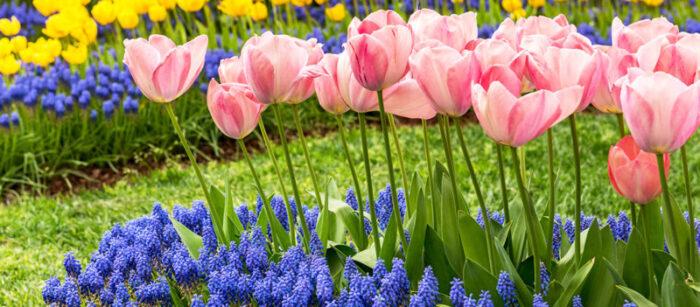
If the place is sunny, choose flowers that prefer more light. Those that are easy to care for are ideal, such as pansies, dahlias, daylilies, perennial asters, phlox, coneflowers and peonies. Bulbs also love the sun, for example, tulips, daffodils, hyacinths.
Yes, most plants prefer sunny locations, but there is a fairly large group that require only a minimal amount of sunlight. If the place intended for the flower bed is shady, choose plant species that look beautiful in the shade. Many shade-loving plants bloom beautifully, so they can beautifully decorate the garden. Maintaining soil moisture is the only thing you need to remember when growing them.
Note! In shaded beds, as in all other places in the garden, follow an important gardening rule: plant plants in large groups. This will give the garden character. Single plants will not be an interesting element of the garden, and after a few seasons they may even disappear from view completely.
Plants that grow well in the shade include: hosta, periwinkle, lupine, violet, ferns, bergenia, hydrangeas, begonias, phlox, etc.
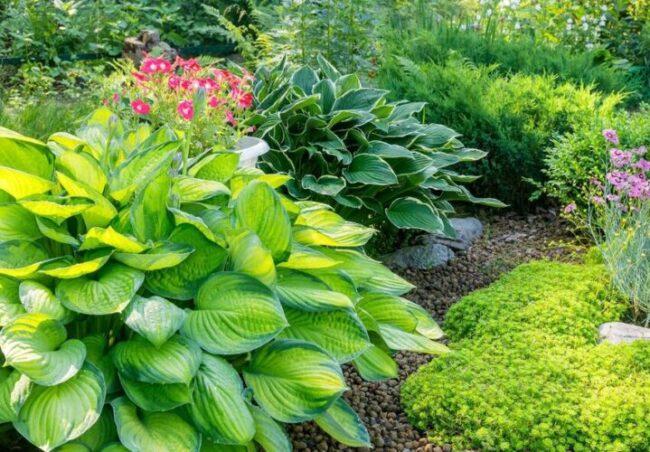
Spring bulbs can be planted in shade or partial shade. If the flowerbed will be shaded most of the day, the best choice will be shade-loving plants: bergenia cordate, tiarelli and brunerra. They enliven shaded areas and make them more attractive and colorful.
Easy to grow plants that bloom in spring, summer and fall
In spring, the flower beds in front of the house and other places in the garden are decorated with spring bulbous flowers: tulips, daffodils, grape hyacinths, hyacinths, snowdrops, primroses. When they finish blooming, they will make room for plants that will bloom in the summer or fall.
Flowers and perennials that bloom beautifully in summer: peonies, daylilies, phlox, marigolds, begonias, garden geraniums, salvia, lavender, echinacea and rudbeckia.
Perennial plants ideal for beautiful summer borders that are undemanding and perennial include rudbeckias and purple coneflowers. They are worth putting together because they create a beautiful composition and feel great in each other’s company.
Flowers for autumn flower beds: asters, dahlias. heather, sedums, garden anemones, chrysanthemums, and echinacea.
It is also a good idea to place plants in the flowerbed that do not bloom (or their flowers are inconspicuous), but have decorative leaves. Thanks to this, even when one group of plants in a flowerbed stops blooming, it will still look very good. All types of ornamental grasses also look beautiful in autumn flower beds.
Plants with attractive leaves have versatile uses in the garden. They are a decoration from spring to autumn. They go well with species blooming both in gardens and on balconies and terraces. They also make a great addition to flower beds.
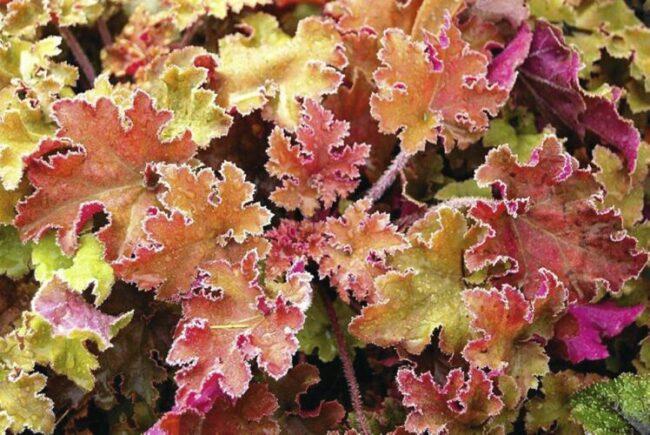
Decorative shape and interesting coloring are the main features of the most beautiful decorative foliage plants.
Plants with burgundy leaves look good against the backdrop of green species; their decorative leaves will be a decoration from summer to late autumn. An interesting shrub with red leaves is Thunberge barberry. The bushes reach 1.5 m in height and are one of the few that prefer shady places.
Ferns are a group of shade-tolerant plants that can be used both to fill large spaces and to create attractive arrangements with perennials such as anemones, bergenia, epimedium, rue and black cohosh.


