


Planting lily bulbs
Lily bulbs are widely available and anyone can plant them. They bloom from June to August and there are almost 120 different species. Lilies can grow in one place for two to three years.
It is worth noting that lilies are quite demanding plants to grow compared to other plants. The growing site must meet certain conditions, both regarding the soil and the environment. Despite this, growing them in the garden is quite possible.
The necessary care procedures will allow you to get beautiful, lush plants that will decorate your garden. The main works include: protecting plants from weeds and their possible removal during the growing season, watering and fertilizing, protection from low temperatures in winter.
The amount of light is important for their development, so the place should be in full sun or light shade. The growing site should be protected from cold winds from the north. Other plants, such as bushes, can provide cover. Lilies grow well near bodies of water because they love both moist soil and moist air. However, they should not be planted in wet clay soil as they cannot tolerate such conditions.
These plants usually grow well in permeable, humus-rich soils. His reaction depends on the type of lily. Most do well in slightly acidic soil. Optimal conditions for the growth of these plants are provided by soil with a pH of 5.5 to 6.5, that is, slightly acidic.
Soil preparation can begin about a month before planting. The soil must be cleared of weeds, loosened and have the required amount of nutrients that the plants will absorb during the growing season. The area should be dug to a depth of approximately 35-40 cm, adding mature compost or peat. You can also feed the soil with ready-made fertilizers. After about two weeks you can start planting the bulbs.
Most lilies that overwinter in the ground are planted at the turn of September and October. The remaining species are planted in the spring. Planting depth depends on the size of the bulbs. It is assumed that the planting depth should be 2.5 – 3 times the height of the bulbs. Only white lily (L. Candidum) is planted shallowly, no deeper than 5 cm.
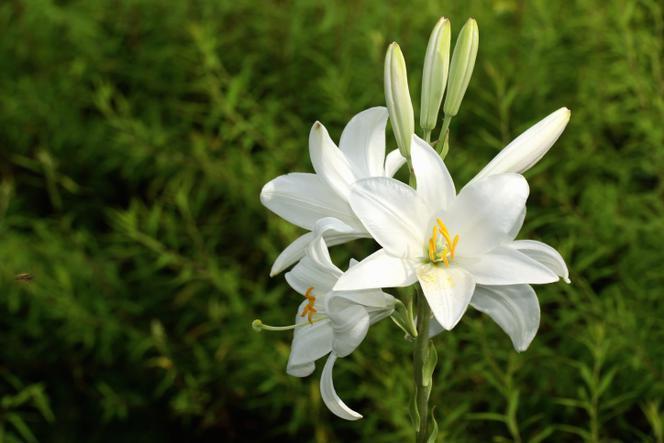
The spacing between plantings depends on the type and expected size of the plant. A distance of 20–30 cm can be used. However, if the plants are planted in groups for a longer period, the distance should be increased to 50 cm.
Plant care
Perennial garden lilies love to grow in moist soil, but do not tolerate excess moisture very well. Therefore, you need to water regularly, but so that the soil is slightly moist. During the flowering period of plants, you should be especially careful to ensure proper soil moisture. It is important not to soak plants when watering, pouring water only onto the soil, as there is a risk of developing gray rot.
Fertilizer
During the flowering period, it is worth feeding the plants with complex fertilizers. This action will cause the plants to bloom profusely. After flowering, it is not recommended to use fertilizers.
Note! In order for plants to become a real decoration of the garden, fading flowers must be systematically removed. Seed production strips the bulb of much of its nutrients, which significantly weakens the onion.
Low temperature protection
Despite the fact that most varieties of lilies tolerate winter conditions well in our country, it is worth protecting them from temperature changes. To do this, create a protective layer by covering the plants with about a 10-centimeter layer of bark or sawdust. In case of severe frosts, you need to create an additional protective layer using coniferous tree branches. Shelter should be done after the first frost, not earlier. In the spring, as the temperature rises, the shelter is gradually removed.
Mulching the land
To limit the growth of weeds, it is worth mulching the ground around the plants. For mulching, you can use compost bark or garden peat. Mulch will also help maintain the required level of moisture in the soil, limiting the process of water evaporation, and will also help maintain the acidity of the soil, which is beneficial for many varieties of lilies.

Ways to get new plants
Lilies are best propagated by adventitious bulbs; propagation from seeds is also possible, but this method is labor-intensive and unpredictable, since the new generation of plants obtained in this way does not inherit the characteristics of the original plants. A faster way to get new specimens is to propagate by bulbs, separated from the mother plant. When the leaves begin to turn yellow and dry, it’s time to separate them. Carefully dig out of the ground and separate the bulbs.
How to propagate lilies from bulbs?
3-4 years after planting, a whole “nest” of 4-6 bulbs is formed underground, which is dug up, divided, and each bulb is planted separately. The number of bulbs formed can be easily determined by the number of stems. It is always recommended to remove the excess ones as this limits growth. After removing the accessory bulbs, the plants develop and bloom better.

The most optimal time for propagating onions is autumn. It is replanted from mid-September, but if necessary, replanting can be done in the spring. Planted large bulbs will bloom already in the year of transplantation, since flower buds have already been laid in them since the fall. Small bulbs – only for next year.
It is best to plant the bulbs immediately after digging. If it is not possible to immediately plant them in a permanent place, in order to prevent the roots from drying out, you should temporarily dig them into moist soil or sprinkle them with a damp substrate (peat, sand). Separating the bulbs, cut off the stem above it. Young plants obtained in this way will bloom in the 2-3rd year of cultivation.
Reproduction from scales
Another way to get new plants is to propagate lilies using scales from dormant bulbs. Healthy, undamaged bulbs are cleaned under running water and then dried. Then carefully remove the scales from the base (about half of the scales are removed from the heel). The rest of the onion can be planted back into the ground.
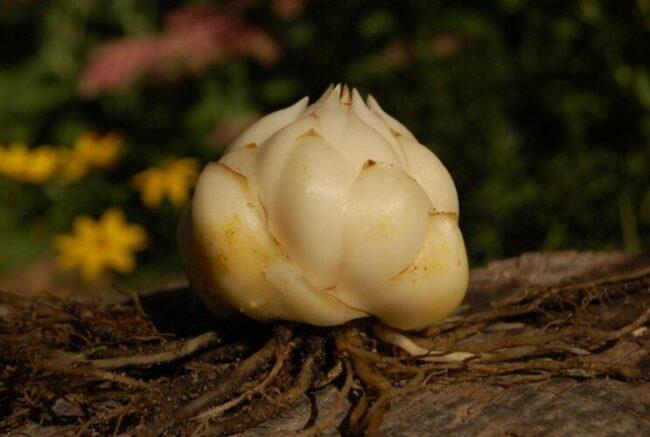
The resulting scales must be treated with a fungicide, for example Captan or Topsin, and dried. This treatment will protect plants from the development of fungal diseases.
Prepared in this way, they are planted in containers filled with a moist, permeable and humus-rich substrate. Place in a shaded place at a temperature of about 20°C for a period of about 2 months, maintaining sufficient soil moisture.
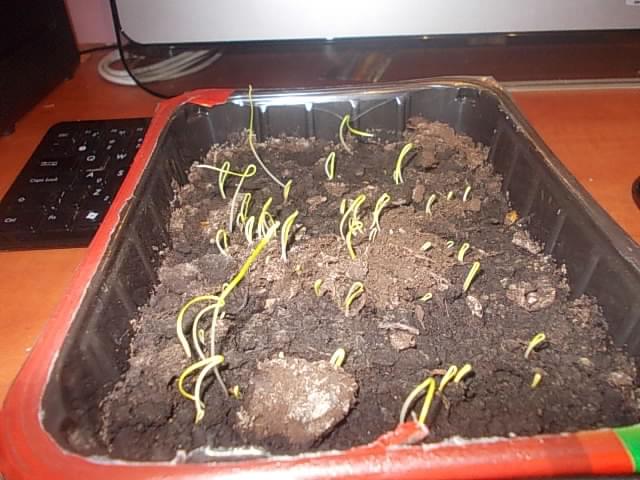
After this time, move the trays to a cool place until the leaves appear, and then plant them individually in pots. After a year, the lily bulbs are ready. In spring, rooted plants are planted in a flower bed.
Additional Information! Lily bulbs cannot be stored like other bulbous plants because they are very delicate and the scales are not protected by any additional covering. It is best to store them in slightly damp peat or sand.
How to propagate lilies by seeds?
The method of growing lilies from seeds is not the best way to propagate lilies. The downside to growing lilies from seeds is that they can take years to bloom.
In the inflorescence of many varieties of lilies, peculiar boxes appear in which seeds are formed. When should I start collecting them? When the lily box is completely dry and turns brown, you can remove the planting material from it. It must be immediately sown in the ground or dried.

First, it should be soaked in a damp cloth until sprouts appear. Then the seeds are sown in the greenhouse, deepening them no more than one centimeter. In May, the strongest and healthiest plants can be planted in the beds, slightly shading their habitat. It is better to leave weak seedlings in the planting box until next spring.


