

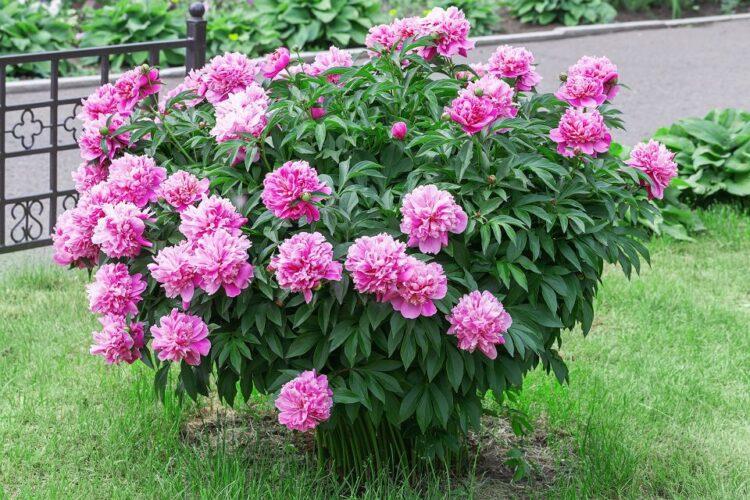
What do peonies look like?
Peonies are perennials that die back during the winter and regrow every year. Some species live up to 100 years, but, in general, most live on average 20-30 years. Almost 30 species are known, but some of the most popular are: Chinese peony, tree peony, medicinal peony and dill peony.
The color of the petals depends on the species and variety, but most often they are shades of pink, as well as red, white, cream or yellow.

The flower buds look like green-pink balls surrounded by thick, interestingly cut green leaves. Their stems are not strong enough to hold large flowers. It is worth using supports for shoots.
The flowering time of peonies depends on the type, variety, as well as the weather and the place where they grow. They usually begin to bloom in late May and bloom most of June, sometimes into July.
The most popular in our gardens is the Chinese peony , which has many varieties. It has large double or semi-double flowers, usually white, with shades of pink and carmine. Blooms in June. The flowers are impressive (up to 20 cm in diameter!) and have a wonderful aroma. The Chinese peony reaches approximately 80 to 100 cm in height. The leaves are strongly dissected, pinnately incisive, darker than those of other species, and become red-burgundy in the fall.

Tree peony (its second name is bush peony) is definitely distinguished by its height, reaching approximately 150 – 200 cm. Flowers can be full, semi-double or flat. In the latter, the center of the flower is very clearly visible. Their diameter is up to 15 cm. Bush peony blooms in May-June. The leaves are quite large and strongly dissected. The shoots become woody over time.

Tree peony grows quite slowly. They will show their full beauty two to three years after planting. In colder regions of the country, growing bush peony is not recommended, as it is not completely frost-hardy and must be covered for the winter.
Medicinal peony – how to recognize it? The lowest variety of peony, reaches a height of about 60 cm. Its flowers are usually double, less often semi-double, and have shades of white, pink and red. The leaves are glossy, also characteristically notched. The underside of the leaves is slightly lighter. Decoctions of some of its parts were once used to treat various ailments.
What is different about dill peony? Its leaves are very tender, strongly cut and therefore resemble dill. This is what sets the dill peony apart from the rest. The flower petals contrast beautifully with the numerous yellow stamens in the center.
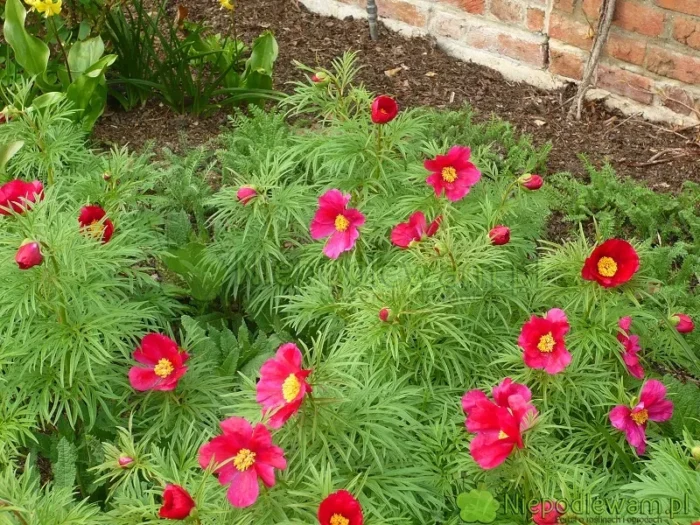
Dill peonies grow to a height of about 60 cm. They bloom early, in May, and sometimes in April.
Planting peonies
When and where to plant peonies? Peony grows best in a sunny or semi-shady location. They should also be protected from strong winds and grow away from trees and shrubs, as they do not like to compete for space, access to light, food and moisture.
They need fertile soil rich in nutrients. The soil must be permeable so that water can drain freely. Stagnant water will cause root rot. If the soil is heavy or very sandy, it can be mixed with compost or manure.
Additional Information! Planting too deeply often results in a complete lack of flowers for many years. The peony bush grows with age. However, they do not respond well to transplantation. If they are planted in a new location, this should be done in the fall at the end of September or October, 6 weeks before the first frost.
It is advisable to plant peonies in early autumn. The optimal time is the end of August – beginning of September. When planted at this time, the peony has time to take root before autumn. Place the plant in the prepared hole, then cover it with the prepared substrate and water it abundantly. Peony can also be mulched. In spring, such mulch must be removed.
Caring for peonies
Peonies like moist soil, so they should be watered. In the first year after planting, carefully keep the peony soil moist. In subsequent years, it is necessary to concentrate watering during intensive flowering and budding, i.e. from May to mid-August. The soil around peonies should be moist, but not wet. Water on the ground, not on the leaves.
Peony bushes can be fed with mineral fertilizers throughout the season. To make them bloom profusely, in the fall, around October, after pruning the shoots, sprinkle with manure. This will not only provide the plant with the nutrients it needs in the spring, but will also provide some protection from frost.
Pruning peonies consists mainly of cutting off faded inflorescences. Remove the stem with pruning shears a few centimeters below the wilted flower. Trimming spent flowers will force the plant to focus on developing roots rather than producing seeds.

Should you trim peony leaves? This is a mistake that will weaken the plant rather than strengthen it. As a result, next year it will bloom worse, not better. Perennial peonies’ leaves begin to dry out quite early, usually at the end of August. When they lose their beautiful appearance, they can be pruned, but not earlier than at the turn of August and September. Shorten shoots 10 cm above the ground.
Why doesn’t the peony bloom?
With proper care, it will delight you with beautiful flowers every year. Growing peonies is based on regular fertilization, watering and pruning, which guarantee abundant flowering. Peonies rarely bloom in the first year after planting. Sometimes, even if all the requirements are met, there may not yet be flowers. If it has been growing in the garden for several years and still does not bloom, or it bloomed and now has stopped, this may mean that:
- not enough sun;
- set too deep;
- the soil is poor and lacks nutrients;
- too much nitrogen fertilizer.
Peony is a sun-loving plant. If it is planted in a place protected from the sun by buildings and tall trees, the shrub may respond by not flowering. Peonies do not like too close company with other plants, especially shrubs and trees, with which they have to compete for water. Large fluctuations in soil moisture can cause a lack of flowering.
Note! If your peony isn’t blooming, it’s also worth checking to see if it has access to enough light and nutrients. Perhaps a growing shrub or tree nearby takes all its microelements or casts too much shadow on the perennial. In such a situation, the plant will develop poorly for obvious reasons.
Inappropriate time or method of planting. If the plant is put into the ground too late or planted too deep, it will not produce flowers. Planting a peony too deeply results in it not blooming and growing poorly.
Peony owners often forget to remove the mulch after winter. As a result, the roots are covered with too thick a layer of substrate (more than five centimeters), and the peony has no chance of blooming.
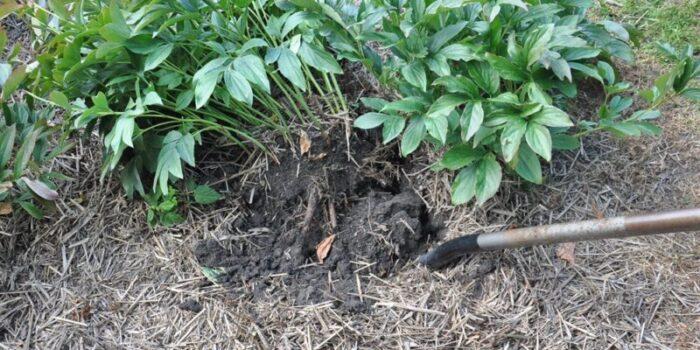
Lack of flowering is often a symptom of various diseases that perennials suffer from. Peony is generally a very unpretentious plant. However, it is susceptible to fungal diseases (grey mold, rot), viral diseases (leaf spot), plant nematodes that feed on the root system of peonies.
Peony faces many dangers, including nematodes and so-called gray rot. You should carefully observe the buds, young shoots and other parts of the plant. If a dark coating appears on them and the peony begins to wither, this is a sign that they should react as soon as possible.
What to do to make a peony bloom? First of all, you should follow the rules of planting, watering, fertilizing and pruning. If necessary, spray the peony with a special fungicide or bactericide. You should use multi-component products that contain not only nitrogen, but also other trace elements such as phosphorus and potassium.
Note! Peonies should not set seed because this will weaken the plant to produce flowers the following season. When peonies finish blooming, they need to be trimmed, but you can’t cut off too much.
Peonies are famous for their wonderful, large and fragrant flowers. Their bushes make beautiful sidewalk edges and low hedges. Peonies also look good mixed with other flowers, such as irises and roses, and below forget-me-nots or violets.


