

Detailed description of the Honey strawberry variety: yield, taste, planting and care features
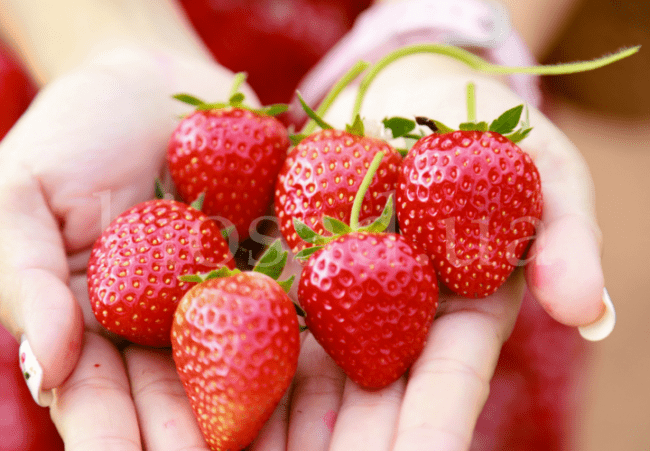
Strawberry Honeyyoye is one of the most popular early-ripening varieties of garden strawberries, bred in the USA. The variety is valued for its high yield, excellent frost resistance and large aromatic berries. The fruits begin to ripen in late May – early June, which makes Honey an ideal choice for early harvesting. It tolerates transportation well. Today, this variety is successfully grown in different climatic zones, including the central zone and the south of Ukraine.
Strawberry Honey characteristics
Pros:
- early fruiting;
- high yield;
- transportability;
- good winter hardiness;
- easy propagation.
Cons:
- taste depends on growing conditions;
- average resistance to gray mold;
- requires regular feeding.
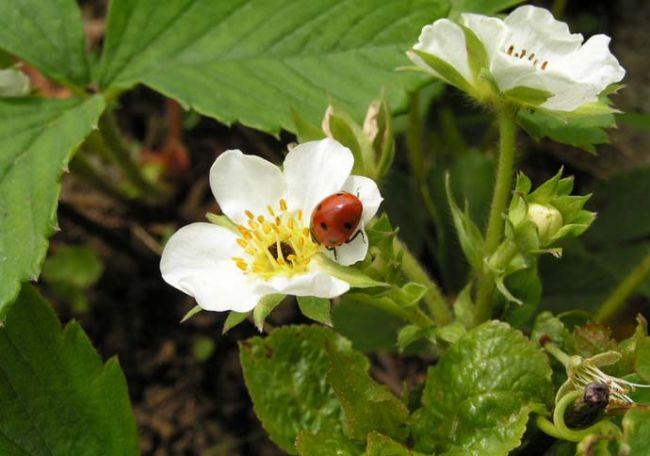
The bushes are compact, with a powerful root system, the leaves are bright green, with a slight shine. The flower stalks are strong, located at the level of the leaves or slightly below.
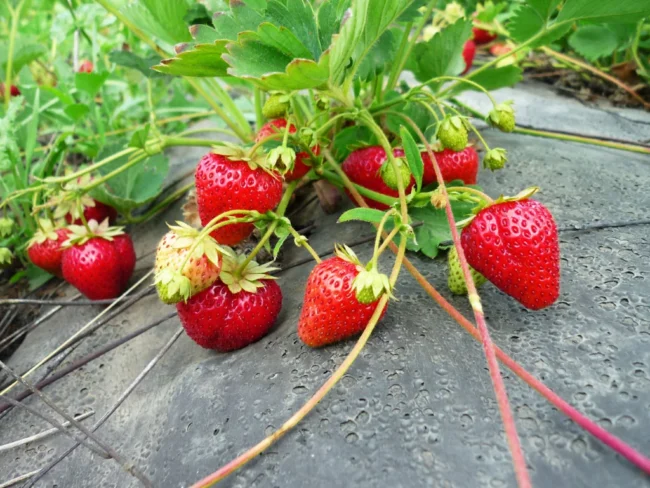
The berries are conical, deep red in color, and have dense flesh, making them easy to transport. The berries weigh between 30 and 50 grams. The taste is sweet with a slight sourness, especially in the first fruits.
Strawberry Honey is suitable for growing in open ground, as well as for commercial production due to uniform ripening and good shelf life. It is resistant to cold, moderately resistant to diseases, requires regular care and fertilizing to maintain a high level of productivity.
Honey shows average resistance to root diseases and powdery mildew, but can be affected by gray mold if there is excess moisture.
How to grow Honey strawberries on your plot, what to feed them with, how to propagate them?
To get a rich harvest, it is important to regularly care for the plants.
Planting Honey strawberries . Proper planting is the key to a good harvest. This variety is demanding of soil, lighting and humidity, so it is important to take into account all the nuances.
Planting dates depend on the climate zone and the gardener’s preferences. In spring, plant from late April to mid-May, when the soil has warmed up well and the threat of frost has passed. In autumn, plant from late August to mid-September, so that the bush has time to take root before frost.
Please note! Spring planting gives the first harvest the following year, autumn planting strengthens the bush for winter. When planting in spring, remove flower stalks in the first year so that the bushes do not waste energy on berries. When planting in autumn, mulch the soil around the bushes (straw, humus, pine needles).
Selecting a location. The Honey variety prefers sunny, wind-protected areas without stagnant moisture. It is not recommended to plant strawberries after tomatoes, potatoes and other nightshades – due to their common diseases.
Soil preparation. The soil should be fertile, light, with neutral acidity (pH 5.5–6.5), which should preferably be prepared 1–2 weeks before planting. Do not plant strawberries after old strawberry beds — the soil may be contaminated with pests and diseases.
Before planting, dig the area to a depth of 25–30 cm, removing weeds and roots. Add per 1 m²:
- 5–6 kg of humus or compost;
- 1 glass of wood ash;
- 30–40 g of superphosphate.
Strawberry Honey planting scheme:
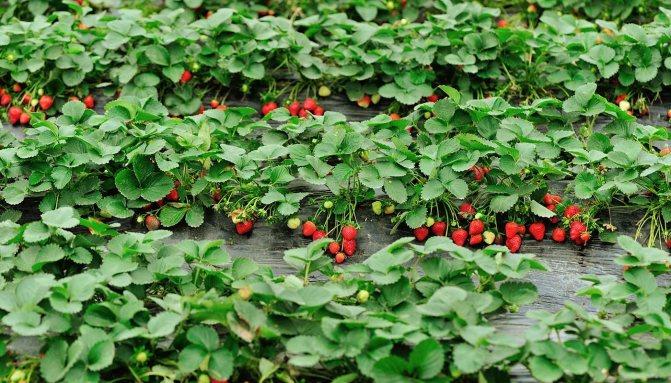
- distance between bushes – 30 cm;
- between rows – 50-60 cm;
- planted so that the heart (growth point) is at ground level.
Before planting, the roots can be soaked for 2-3 hours in a stimulant solution (for example, “Kornevin”). For good growth and ventilation, the plantings should not be thickened. If planting is in the fall, it is necessary to cover the beds with agrofibre for the winter.
Please note! Do not deepen the rosette, otherwise the bush may rot, and do not plant too shallowly – the roots will not take root. Immediately after planting, water each bush generously (0.5-1 liter of water). When planting in spring, water every 2-3 days during the first week. In autumn, water less often (in dry weather).
Watering is moderate but regular. It is especially important during the flowering and berry filling period. Use drip irrigation or water under the root. Mulching helps to retain moisture, suppress weeds and prevent berry rotting. Straw, hay, pine litter, black agrofibre are used. Loosening is carried out after each watering, weeds are removed so that they do not deplete the soil.
Pest control. In spring, spray with garlic infusion or special preparations (Fufanon, Aktara). In autumn, cut off old leaves and burn them to reduce the risk of infection.
Fertilizing strawberries with Honey in spring and summer
Proper nutrition ensures abundant fruiting. The Honey strawberry variety is highly productive, but to maintain productivity for 3-4 years, it is important to provide the plant with adequate nutrition. The best fertilizers for strawberries Honey promotes active growth, abundant flowering and the formation of large, sweet berries.
In spring, at the beginning of growth, immediately after the snow melts, feed with urea or ammonium nitrate (30 g/10 l of water). During the budding period, use a complex fertilizer with potassium and phosphorus.
In summer after harvesting – ash infusion, chicken manure, herbal infusion. Top dressing helps the bushes to recover and lay the harvest for the next year. In autumn – phosphorus-potassium fertilizers (for example, superphosphate and potassium sulfate).
Two weeks after planting, you can feed the plants with a mullein solution or herbal infusion. It is important not to overfeed with nitrogen – this will lead to fattening of the plants to the detriment of fruiting.
Reproduction of Honey strawberry
Strawberry Honey easily and actively reproduces, especially in favorable conditions. The main method is runner propagation, but it is also possible to divide an adult bush.
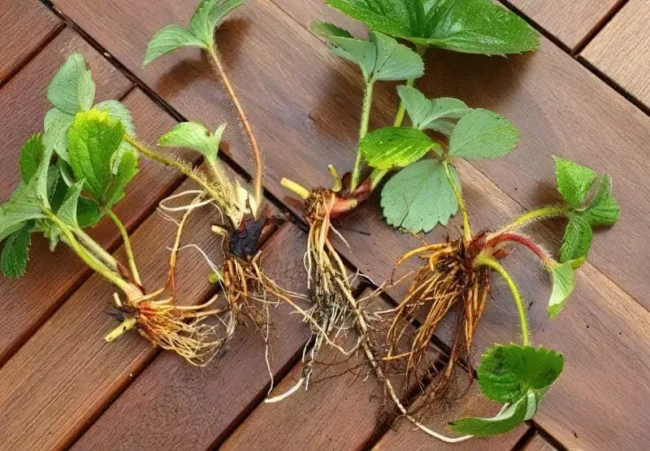
The variety actively produces runners that can be used for propagation. Runners are a natural way of vegetative propagation of strawberries. Already in the second year after planting, Honey bushes produce powerful shoots with young rosettes. The best time for rooting is from late June to August.
How to root mustache:
- select strong tendrils of the Honey strawberry with a developed rosette, leave 1-2 of the strongest tendrils, and remove the rest;
- pressed to the ground and sprinkled with moist soil;
- maintain moderate humidity, roots will appear in 2-3 weeks;
- After 2-3 weeks, the rooted bush can be transplanted to a permanent location.
The division of the bush is carried out in early spring or at the end of August. The method is less popular than rooting of runners, but can be useful when there is a shortage of planting material.
With proper planting and proper care, you can enjoy large, juicy and aromatic berries already at the beginning of summer. This variety is suitable for both personal use and for sale – due to its attractive appearance and resistance to transportation.


