


Planting strawberries correctly
The strawberry plantation must be renewed every 3-4 years. There are two suitable periods for planting garden strawberries: spring and autumn. The best time to plant strawberry bushes is August. You can replant in September, but there is a risk that the plants will not take root well.
When planting strawberries in a new location, make sure the soil is rich in nutrients. Before planting strawberry seedlings, the soil should be moistened by pouring a little water into each hole. After planting, the soil around the bushes should be carefully compacted by hand and covered with mulch. For this purpose, black agrotextiles are most often used, which serves as mulch, while facilitating the heating of the beds and limiting the growth of weeds.
Why is it worth planting strawberries on agrotextiles?
Planting strawberries on black covering material has so many advantages that it has practically replaced other forms of growing these fruits, especially among professionals. Thanks to this method, yields are higher and faster, the necessary weed control treatments are reduced, and the harvest itself is cleaner and more enjoyable.
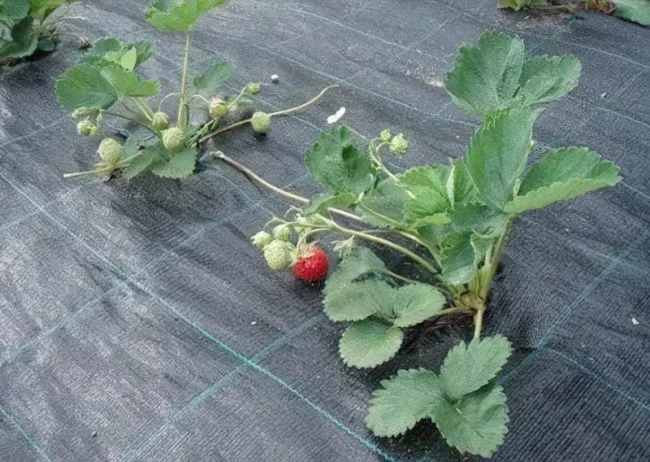
Growing strawberries on agrotextiles (i.e. mulching the soil) is one of the most effective agrotechnical measures to prevent the development of weeds. Agrotextiles for mulching reduce the problem of weeds and the need for mechanical and chemical treatments to almost zero.
Planting strawberries on this material ensures sufficient soil moisture, because water easily penetrates into the ground, thereby reducing evaporation. Black agrofibre for strawberries:
- accelerates plant ripening;
- promotes their development;
- makes harvesting very easy;
- limits fruit rot.
The soil covered with black agrotextile warms up faster, which significantly speeds up the start of the growing season and at the same time speeds up the ripening and harvesting of fruits. Optimal soil temperature promotes more efficient absorption of nutrients from the soil, which allows for higher yields.
Note! Agrotextiles, as an air- and moisture-permeable material, despite the fact that they cover the soil, allow water to freely penetrate deep into the substrate and prevent it from evaporating excessively, so the soil always remains moist.
Strawberries growing on agrotextiles are not contaminated after harvest, since they are separated from the soil by a protective layer. Moreover, due to separation from moist soil, the fruit is less susceptible to rotting, and its collection is much more convenient and faster.
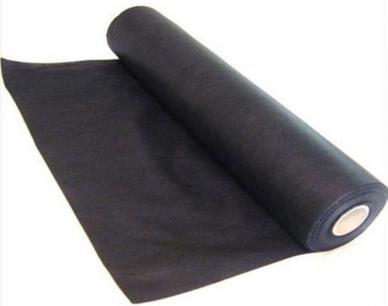
There are two types of agrotextiles on the market: covering and mulching. The former are used to cover crops to protect them from adverse weather conditions, for example to protect crops from winter. In turn, black agrotextiles are used to mulch the ground, which are much thicker than covering materials, which provides protection against weeds.
How to plant strawberries on agrofibre
What agrotextile should I plant strawberries on? For this purpose, black is suitable for mulching soil with a thickness of at least 50 g/m2. Before laying the material, all weeds are carefully removed from the soil. It is also worth fertilizing the soil, for example, with mineral fertilizer or compost. Before planting a plantation, it is worth considering the substrate itself. Light, airy and moderately fertile soils with a pH of 5.5-6.2 are best suited for planting strawberries.
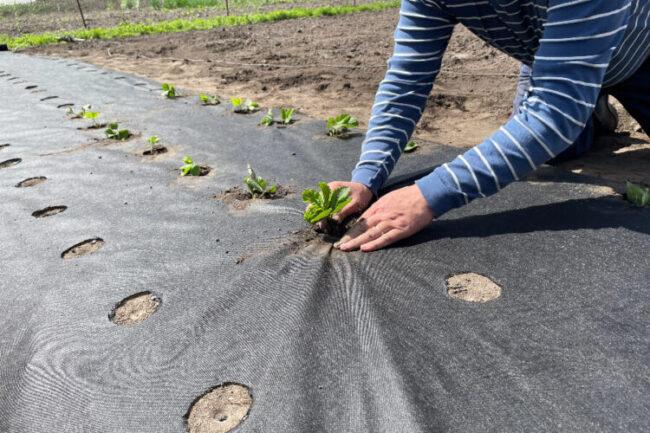
Black agrofibre for strawberries should be spread so that it is tightly stretched without creases or folds. Attach it to the ground using agrotextile pins or wire bent into a horseshoe shape. Then X-shaped cuts are made so that the strawberry seedlings can be placed in the soil. Their length should be approximately 10 cm.
Arrangement of strawberries on agrotextiles
Typically, the distance between rows should be approximately 50 cm, and between plants in a row – 15-35 cm. Low varieties are planted more densely (every 15-25 cm), and vigorous ones – less often. On less fertile soils, strawberries should be planted at a shorter distance, and on fertile soils – at a greater distance, so that they do not compete with each other during intensive growth.
Additional Information! Strawberries should be planted so that their lower leaves are not covered with soil and the roots do not protrude above it. In addition, you should be careful not to bend the plant roots when placing strawberry seedlings in the holes.
After all the strawberries have been planted on the agrotextile, excess soil is removed so that it becomes relatively clean, and then the bed is watered abundantly.
Advantages and disadvantages of growing strawberries on agrofibre?
Planting strawberries on black covering material is one way to increase the quantity and quality of the harvest, as well as speed up its production, while reducing the amount of care work. This growing method has advantages and is currently the dominant method of growing strawberries in plantations.
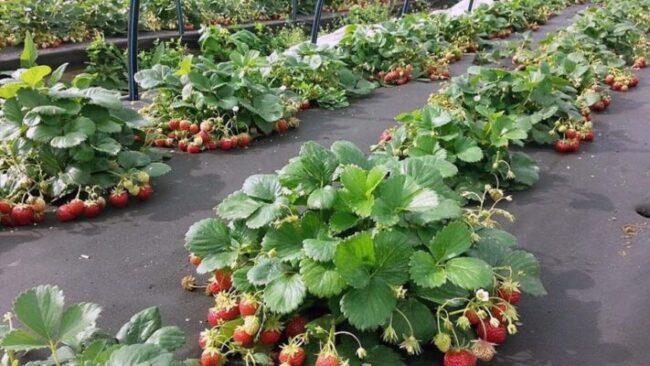
This method accelerates the development and growth of strawberries, reduces the amount of weeding and makes harvesting easier. The only disadvantage of this method is the need to purchase and properly place agrotextiles, but compared to the cost of herbicides and the amount of time required to care for strawberries grown simply in soil, this disadvantage is really of secondary importance.


