

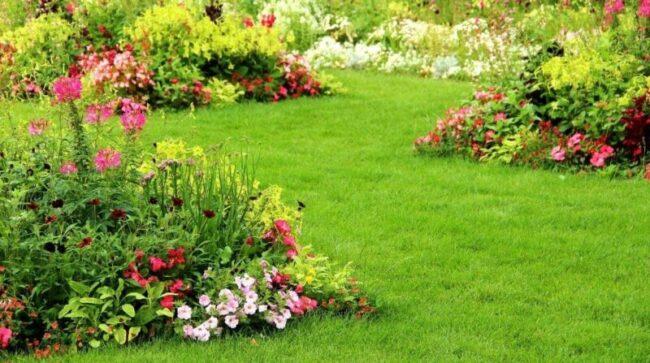
Flowering garden perennials: features
In summer we can arrange flower beds. Usually these are annual or perennial species. Perennial flowers for open ground bloom in the garden for a long time, they do not require special care and are undemanding to soil and watering.
Long-blooming perennial flowers for the garden allow you to enjoy a beautiful view for a long time. Such plants do not require annual planting, so they will be an excellent solution for those who do not have enough time or energy for frequent garden work.
Advantages of perennials for a summer cottage:
- do not require constant replanting;
- they are well preserved during frosts;
- they overwinter without problems;
- undemanding in care;
- throughout the summer period they add color to the summer cottage;
- This is the best base for creating flower beds.
- suitable for mixborders, flower beds and borders;
If the ground is shaded for most of the year, sun-loving species will not survive in the absence of sunlight. Perennials thrive in the shade of trees and shrubs.
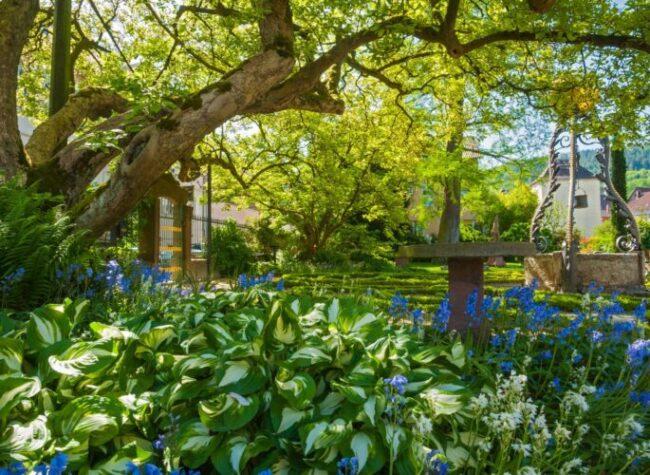
The most beautiful long-flowering perennials can be found without much difficulty. Without a doubt, they are worth planting and looking at for months! Flowers blooming from spring to autumn have a variety of colors, shapes and heights, allowing you to create compositions for every taste.
Care instructions
Even the most unpretentious perennials require minimal care to maintain their decorativeness and flowering period. Most flowers prefer fertile, well-drained soil. Planting perennial flowers is possible in several ways: using bulbs, roots, seeds.
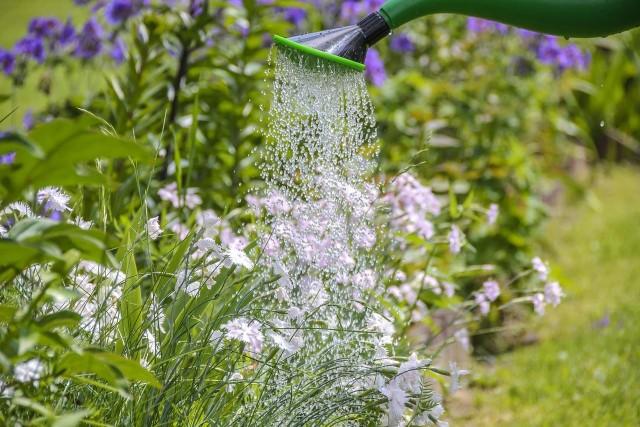
Timely watering. Water the plants in the morning or evening to avoid sunburn. During dry periods, water 2-3 times a week, especially during active flowering. Overwatering is usually more dangerous than overdrying.
Fertilizers are used to provide plants with the necessary nutrients. As a rule, a balanced complex fertilizer is suitable for most flowers. It can be given with each watering or less often, depending on the product and the calculated dose.
Mulching protects the roots from overheating and retains moisture. Use bark, straw, sawdust, peat, decorative chips. Renew the layer 1-2 times per season.
Pruning. Regularly pick off faded flowers. Removing faded buds stimulates the formation of new ones. Some perennials (for example, phlox, geranium, sage) can bloom again after pruning. In autumn, shoots are cut to the root – this makes wintering easier and reduces the risk of diseases.
Division and rejuvenation of the bush . Once every 3-5 years, divide old bushes, especially daylilies, echinacea, phlox. Division stimulates growth and flowering, prevents thickening.
Protection from pests and diseases . Do not plant flowers too close together – good ventilation reduces the risk of fungal infections. Inspect plants for spots, plaque, holes. Use biological preparations or folk remedies at the first signs of disease.
Garter of tall plants. Tall perennials need support. They are tied to stakes or decorative supports to maintain the shape of the flower bed.
Which long-flowering perennials to choose?
There are many species that can bloom from early summer to autumn. What flowers to plant in the country? Low-growing perennials (up to 30 cm) are ideal for the foreground of a flowerbed, border or alpine slide. In order for these long-blooming garden flowers to grow properly, they only need to be planted in a sunny place.
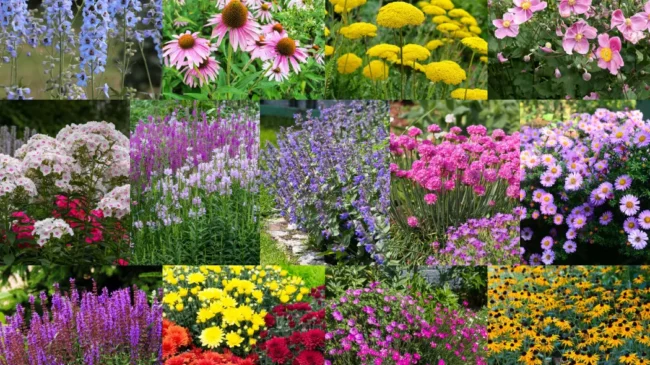
Alyssum (lobularia) blooms from May to September. A fragrant, carpet flower with white, pink, lilac shades, looks great along the edges of paths.
Aubrieta. Blooms from spring to mid-summer. Forms dense cushions of bright purple or pink color. Ideal for rockeries and alpine gardens.
Phlox subulata blooms from May to July, with a second bloom in September. Pruning after the first bloom stimulates a second bloom.
Saxifrage loves partial shade. Delicate inflorescences and delicate leaves decorate the flowerbed from late spring to mid-summer.
Pansies amaze with their bright colors. They do not require special care. They bloom throughout the summer.
The pink dotted carnation forms a compact lawn of fine leaves and has elegant carmine-red flowers. Pink dotted carnations bloom from June to the end of October. They can reach up to 15 centimeters in height. Of course, they also need some water and enough space.
Medium-sized perennials (30–70 cm). Suitable for the center of a flowerbed or mixborder. They bloom brightly and for a long time.
Garden geranium blooms from May to autumn. Easy to care for, frost-resistant. Colors: purple, pink, blue.
Lavender is a fragrant and decorative perennial. It blooms from June to August. It attracts bees and repels mosquitoes.
Bellflower (Carpathian, peach-leaved ) blooms all summer with regular pruning of faded buds. Combines with daisies, geraniums, sage.
Sage (Salvia perennial). Blue or purple, blooms until September. Attracts pollinators.
Tall perennials (70 cm and above) become the central accent in a flower bed or the background.
Purple coneflower blooms from July until frost. Medicinal and ornamental plant. Looks good in naturalistic gardens.
Rudbeckia . Yellow and orange “suns” appear from midsummer to autumn. Resistant to heat and drought.
Daylily blooms abundantly, is resistant to diseases and freezing. It is good for summer cottages and has 25 species. It grows in one place for more than 10 years. Such a long period is explained by its unpretentiousness to the soil. The color palette is from white to burgundy.
Verbena bonariensis. Thin tall stems and light lilac inflorescences. Blooms all summer until late autumn.
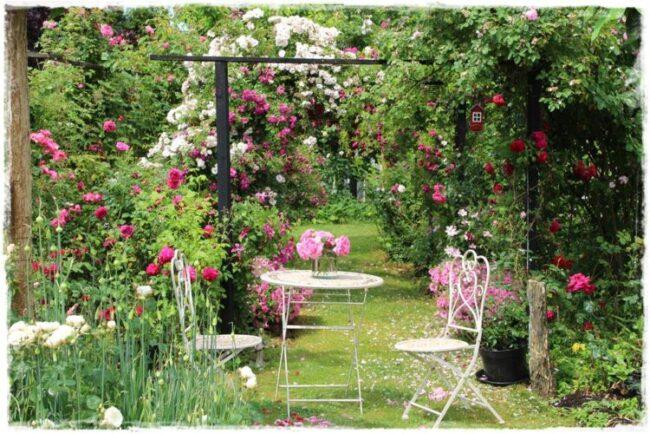
Climbing perennials are distinguished by their special beauty. If you want to decorate a fence, pergola, arch or the facade of a house, choose climbing plants.
Clematis blooms from June to September, loves sun and moisture. Choose varieties with long flowering (for example, Jackman’s clematis).
Climbing rose can bloom in waves all summer. Small flowers are collected in inflorescences, the diameter of which usually does not exceed 5 cm. The color of the rose depends on the variety: pink, red, coral, white, yellow. Requires shelter for the winter, but pays for it with beauty.
Honeysuckle Caprifolium. Decorative, fragrant, blooms in June-July, with possible repetition. Quickly twines around the support.
Hops are unpretentious, decorative, and produce a dense green wall. Flowering occurs in midsummer.
Flowers for the border
Border flowers are intended for placement along paths. The color scheme and flowering time are taken into account. All plants should be in harmony with each other.
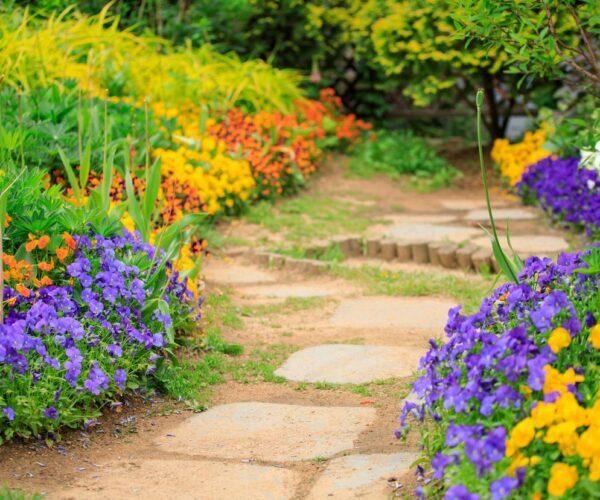
When creating a perennial border, it is important to correctly arrange the plants by height:
- leading edge: alyssum, aubrieta, sedum, dwarf hosta;
- middle tier: lavender, geranium, sage, bells;
- background: rudbeckia, echinacea, daylily, paniculate phlox.
To make a flowerbed in your dacha bloom all summer, it is enough to choose long-flowering perennials correctly. Combine them by height, color and flowering time, not forgetting about climbing plants for vertical gardening.
Please note! Consider not only the height, but also the flowering time, so that the border is decorative all summer long.
How to achieve continuous flowering? Combine plants with different flowering periods (spring, summer, autumn). Remove faded buds – this stimulates re-flowering. Use mulch and fertilizers – this supports the root system and the splendor of flowering. Add ornamental grasses or ground cover plants – for background and structure.
Proper care is the key to abundant and long-lasting flowering: watering, fertilizing, pruning. Perennial flowers for the dacha, having planted once, can get stable flowering from year to year without extra effort.


